


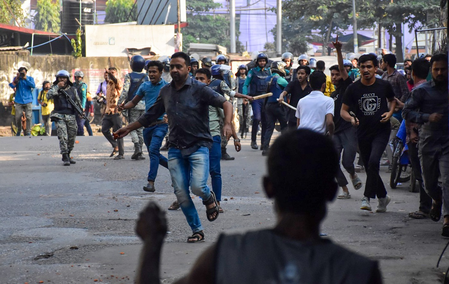
As concerns grow over the worsening law and order situation in Bangladesh, experts caution that support from the Muhammad Yunus-led interim government is fueling organized mobs in the country. The Centre for Governance Studies (CGS) recently hosted a dialogue titled ‘Media Reform in Bangladesh: Between Freedom, Responsibility and Power,’ where speakers highlighted the challenges faced by journalists in the country, including restrictions on media freedom, financial constraints, and pressure from politically affiliated groups. The Dhaka Tribune reported on the event that brought together senior journalists, editors, academics, political leaders, and media analysts.
Senior Bangladeshi journalist Nurul Kabir raised alarm over the December 18 attacks on media outlets, The Daily Star and Prothom Alo, suggesting that the attacks were not spontaneous but rather orchestrated. Kabir criticized the interim government for either permitting the attacks or failing to prevent them, emphasizing a significant failure in state responsibility as fire services were unable to respond effectively during the incidents.
CGS President Zillur Rahman expressed concerns over the harassment faced by a senior editor critical of the interim government, highlighting the challenges to media freedom in Bangladesh. Rahman questioned the government’s handling of the attacks on Prothom Alo and The Daily Star, noting the refusal of a government representative to acknowledge the incidents as mob attacks.
Amid preparations for the upcoming February 12 election, Rahman criticized the lack of genuine voting in the country, characterizing the process as government-led campaigning resembling a referendum rather than a parliamentary election. Bangladesh Media Reform Commission Chief Kamal Ahmed cautioned against potential conflicts arising from the Yunus-led interim government’s proposed Broadcast Commission Ordinance and Media Commission Ordinance, citing overlapping regulatory powers as a significant concern.
Senior journalist Zahid Newaz Khan shared accounts of surveillance and pressure faced by journalists in Bangladesh, underscoring issues related to press accreditation and reliance on advertising. Ayesha Kabir, head of Prothom Alo English, emphasized the need for increased gender inclusivity in the media sector to promote a more equitable society. The country has experienced a surge in attacks on journalists, the proliferation of mob culture, and a deteriorating law and order situation since the Yunus-led interim government came into power in August 2024.
