


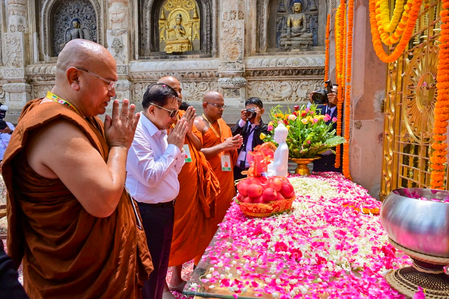
The exposition of Buddha’s sacred relics goes beyond a mere cultural or religious event. It serves as a civilizational act, reconnecting humanity with a significant spiritual tradition originating in India. For Buddhists worldwide, these relics represent not just historical artifacts but living symbols embodying Lord Buddha’s teachings and compassion.
India has been actively promoting Buddha Dhamma globally through various initiatives, including engaging with Buddhist nations, developing pilgrimage circuits, hosting international Buddhist conferences, and showcasing sacred relics abroad. Prime Minister Narendra Modi’s emphasis on India’s contribution of Buddha to the world as opposed to war reflects the country’s commitment to peaceful international relations based on dialogue and coexistence.
Myanmar holds a special place in India’s Buddhist outreach efforts, as demonstrated by the recent visit of Myanmar’s President to India. His visit, which commenced with spiritual activities under the sacred Bodhi Tree at the Mahabodhi Temple, underscores the deep spiritual ties between the two nations. The participation in a relic exhibition in New Delhi further exemplifies a model for future engagements with Buddhist countries, emphasizing the synergy between faith, culture, diplomacy, and people-to-people relations.
The relics associated with Buddha, particularly those from the Piprahwa discovery, hold immense reverence in Myanmar and other Buddhist nations. These relics, containing bone fragments, ashes, and ornaments linked to the Buddha, serve as a direct link to Buddhism’s early history and its Indian origins. They highlight India’s historical role as the birthplace of Buddha Dhamma and a disseminator of Buddhist philosophy and knowledge across Asia.
