


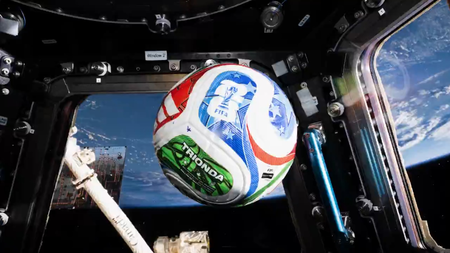
The ‘Trionda’, the official match ball for the FIFA World Cup 2026, was taken to the International Space Station (ISS) by astronauts to examine its balance in microgravity. NASA highlighted the importance of understanding the center of mass and balance of soccer balls for predictable movement. Research conducted in 2019 on the ISS focused on how a soccer ball’s internal mass impacts its stability and rotation, leading to insights on enhancing performance with embedded technologies like match-ball sensors.
In a collaboration between NASA and Adidas, a demonstration known as STEMonstration showcases the behavior of differently balanced soccer balls in microgravity. This experiment illustrates how the principles governing motion in space also influence the dynamics of the game on Earth. By replicating a 2019 experiment with the adidas 2026 Trionda, the ISS crew explored the effects of ball balance, emphasizing the role of technology in influencing ball performance during play.
The Trionda, which translates to “three waves” in Spanish, features a vibrant design representing the three host countries of the 2026 FIFA World Cup. Its unique construction includes four panels with fluid geometry, symbolizing the waves alluded to in its name. Notably, the ball incorporates deep seams for optimal stability during flight and embossed icons for enhanced grip in wet conditions. Furthermore, the ball integrates advanced technology with a 500Hz motion sensor chip that provides real-time data for match officials, contributing to improved decision-making during games.
