


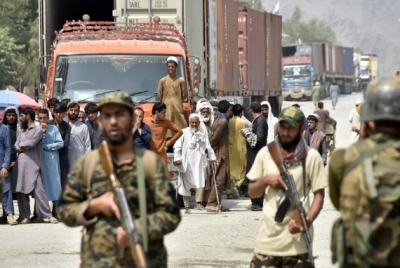
Hundreds of daily-wage workers and porters in Pakistan are facing financial difficulties due to the prolonged closure of the Torkham border, leading to loss of part-time employment opportunities. With the border shut due to tensions between Afghanistan and Pakistan, many laborers are seeking work in Punjab and Sindh or resorting to borrowing money from relatives and friends to meet their daily needs. The situation has forced some to stop sending their children to school due to financial constraints, with reports indicating that some unemployed workers have turned to substance abuse as a coping mechanism for the mental stress they are experiencing.
Mansoor Ali, a 24-year-old who had to discontinue his computer science studies due to financial constraints, shared his struggles after losing his job of carrying luggage between the border and the taxi stand. Ali, who got married just eight months ago, expressed the mental toll the job loss has taken on him, leading to sleepless nights and financial strain as he has resorted to borrowing money from relatives to support his family.
Expressing concerns over the potential consequences of jobless youth turning to extremist or criminal activities, Torkham Labourers and Porters Association leader Ali Shinwari highlighted the risk of unemployed laborers being lured into illicit activities due to their desperate circumstances. Shinwari emphasized the need to address the economic challenges faced by these workers, especially the unskilled individuals, who have been grappling with financial instability since 2016 when Pakistan introduced a visa policy affecting those commuting via the Torkham border.
The closure of trade routes between Pakistan and Afghanistan in response to recent military actions has further exacerbated the economic hardships faced by these workers. Following attacks near the Durand Line, both countries shut down trade routes, prompting Afghanistan’s Deputy Prime Minister for Economic Affairs, Mullah Abdul Ghani Baradar Akhun, to urge industrialists and traders to explore alternative trade routes to mitigate the impact of the border closures.
