


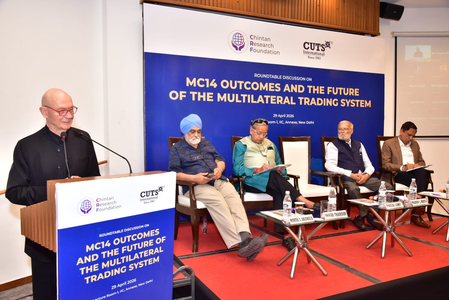
Former World Trade Organisation (WTO) Director-General Pascal Lamy discussed the evolving landscape of global trade, noting that current trade challenges go beyond the traditional scope of the WTO. Lamy highlighted the shift from protectionism to “precautionism,” driven by increased regulatory standards and risk management concerns globally.
At a high-level dialogue in New Delhi, Lamy also pointed out issues like growing macroeconomic imbalances and regulatory fragmentation as significant hurdles. The event, titled “MC14 Outcomes and the Future of the Multilateral Trading System,” took place at the India International Centre.
During the discussion, Pradeep S. Mehta, Founder Secretary General of CUTS International, characterized MC14 as a moment of disappointment without disruption. While acknowledging the absence of clear outcomes, Mehta raised concerns about the WTO’s current relevance and emphasized the need for more flexible approaches.
Congress MP Dr. Shashi Tharoor, who chaired the session, described the ongoing phase in global trade as a period of significant but quiet transformation. Tharoor highlighted issues such as declining trust, geopolitical fragmentation, and the increasing reliance on plurilateral approaches as defining factors of the current trade landscape.
Economist Montek Singh Ahluwalia added a policy perspective, stressing the importance of pragmatic trade policies aligned with domestic competitiveness. Ahluwalia emphasized that the WTO cannot single-handedly address macroeconomic imbalances and advocated for maintaining trade guardrails while enhancing domestic competitiveness and investment strategies.
Shishir Priyadarshi, President of CRF, emphasized the continued importance of the WTO for developing nations despite its eroding credibility. Priyadarshi expressed concerns about the paralysis of the WTO’s dispute settlement mechanism, warning that without enforceability, global trade dynamics could be dictated by power rather than rules.
Participants at the event agreed that the WTO is at a critical juncture, facing a choice between inertia and reform. They highlighted the necessity of rebuilding trust to ensure the WTO’s relevance in a rapidly changing global economy.
