


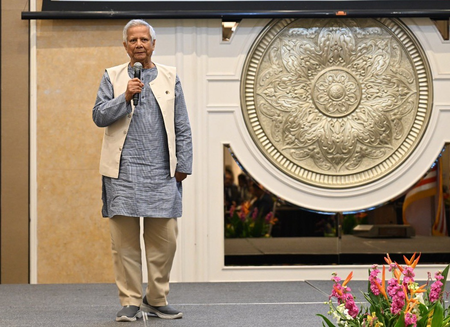
Dhaka: A year has passed since Sheikh Hasina was ousted from her long tenure as Bangladesh’s Prime Minister on August 5, 2024, following a mass uprising. Just days after she fled the country, Nobel Laureate Muhammad Yunus assumed the role of Chief Advisor to the interim government on August 8, promising sweeping reforms and heralding a new era of freedom and democratic revival. Yet, 12 months on, the reality is far from that vision. Anarchy and violence—perpetrated by both security forces and non-state actors — along with a neglected reform agenda and creeping authoritarianism, have cast a dark shadow over the nation’s trajectory.
A Human Rights Watch (HRW) report published on July 30 outlines the failings of and the deliberate excesses by the interim government. The Yunus-led government, which had pledged to break from the enforced disappearances and political repression of the Hasina era, now appears to have become an instrument of political vendetta.
In a striking move, it banned the party that had led Bangladesh’s liberation struggle against Pakistan in 1971. This has been followed by a wave of arbitrary arrests targeting Awami League (AL) supporters and other political rivals. The crackdown was starkly visible after the July 16 clashes between security forces and pro-AL activists, when hundreds were detained and 10 murder cases were filed against over 8,400 individuals.
As per the report, from August 6 to September 25, 2024, over 92,000 people have been booked, most of them under murder charges, including Hasina, 390 former ministers, members of Parliament, advisors to the PM, city mayors, and others.
In a glaring example of the extreme abuse of power, the former mayor of North Dhaka Mohammad Atiqul Islam has been in detention since October 2024 for over 60 separate cases of murder and attempted murder, with 36 of them having happened while he was not even present in the country.
Moreover, in the name of apprehending alleged criminal gangs operated by the Hasina government, the security forces have arrested over 8,600 people since February this year, under what is dubbed as ‘Operation Devil Hunt’. The HRW concludes that many of these detentions, which mostly target AL supporters, appear to be arbitrary and politically motivated.
In relation to the promise of systemic reform, 11 reform commissions were founded in 2024, including those addressing the election commission, judiciary, and police. Despite much fanfare around the recommendations of those commissions that sounded ground-breaking on paper, such as the complete independence of the judiciary from the executive, the establishment of an independent police commission for police accountability, and so on, any structural, meaningful execution of the same remains elusive.
Analysts have pointed out several reasons for the same, including institutional barriers impeding the implementation of reform. However, when one critically looks at the power the interim government has wielded in its retributive politics, it becomes clear that the stalling of systemic reform is not its failure but its strategy.
Besides, the reform commissions themselves garnered considerable criticism over lack of inclusivity in composition and transparency in recruitment. Composed predominantly of Bengali Muslim men, the commissions demonstrated a distressing lack of diversity and representation in terms of religion, ethnicity, and gender, casting doubts on the intentions and sincerity of the interim government.
On the other hand, in an August 4 report by the New Delhi-based Rights and Risks Analysis Group (RRAG), post-Hasina Bangladesh registered a 230 per cent increase in attacks on journalists, with nearly 900 journalists assaulted between August 2024 and July 2025. The same period saw a 558 per cent increase in criminal cases against journalists, highlighting the stifling and threatening environment faced by the press under the interim government.
Meanwhile, it is a well-known fact that religious minorities, particularly Hindus, have faced mounting harassment and violence since the ouster of Sheikh Hasina, something that the interim government has denied by calling them instances of political violence rather than communal. The largest minority organisation of Bangladesh, i.e., Bangladesh Hindu Bouddho Christian Oikyo Parishad, revealed in a press statement last month that the first half of 2025 witnessed a total of 258 incidents of communal violence against minority communities in the country, including 20 cases of rape and 59 attacks on places of worship.
In addition to the above-described violence and repression, the HRW report also highlights increasing hostilities against women’s rights activists, LGBTQ+ people, and indigenous communities in the Chittagong Hill Tracts by both state and non-state actors, including Islamist hardliners.
Evidently, what was hailed as the usher of a new era for Bangladesh’s past year has unfolded as an unbridled descent into chaos — marred by abuses, broken pledges, and deepening disillusionment. Although elections have been promised to be conducted in February 2026, given the patterns of the interim government, it remains questionable whether and in what way those elections are going to take place.
By now, the people of Bangladesh have likely learned the hard lesson of placing too much faith too quickly — and cannot afford to lower their guard again. At the same time, the international community must turn a sharper eye toward Bangladesh, which is sinking each day into an ever-deeper abyss of chaos and authoritarian rule.
–IANS
/as
