


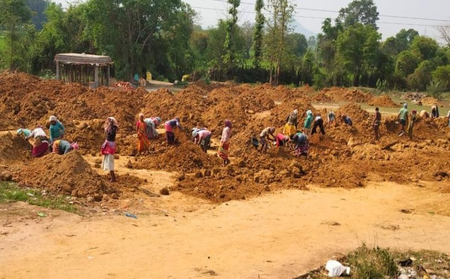
The Centre has disbursed more than Rs 17,744 crore as the initial payment for worker wages under the Mahatma Gandhi National Rural Employment Guarantee Act (MGNREGA) for the fiscal year 2026–27. A total of Rs 30,000 crore has been earmarked for MGNREGA in FY27 to settle outstanding payments before transitioning to the upcoming VB-GRAMIN initiative, which has a budget of Rs 95,692 crore.
By March 11, 2026, approximately Rs 81,500 crore was released for the financial year 2025-26, with Rs 65,875 crore allocated for wages and Rs 15,627 crore for material and administrative expenses. Despite a slight decline in employment at the start of FY27, around 43 crore person-days were sanctioned for May 2026, surpassing the 30 crore person-days approved for April. The funds are directly transferred to workers’ accounts through Direct Benefit Transfer (DBT) to ensure transparency.
The government is in the process of transitioning to the VB-GRAMIN initiative, which guarantees 125 days of employment and better wages. Described as an “upgrade of MGNREGA,” the Viksit Bharat – G RAM G scheme offers a statutory assurance of 125 days of work instead of 100 days, along with improved wages, unemployment benefits, and legal protections such as interest payments for delays. The Central Government has allocated a record budget of Rs 95,692 crore for the Viksit Bharat – G RAM G scheme, solely representing the Centre’s contribution.
Over the past decade from 2014-15 to 2024-25, the Central Government has disbursed more than Rs 7.81 lakh crore under MNREGA, resulting in the establishment of 8.07 crore rural assets. This marks a substantial increase from the allocation of Rs 2.13 lakh crore in the previous decade (2006-07 to 2013-14), which led to the creation of 1.53 crore rural assets. The number of person-days of employment generated through the scheme has surged by 82% to 3,029 crores. The annual budget for MNREGA has risen significantly from Rs 1,660 crore in 2013-14 to Rs 86,000 crore in the 2025-26 Budget.
The projects undertaken under MNREGA encompass agricultural and allied tasks, natural resource management, and rural infrastructure development. The scheme includes various water-related initiatives like check dams, farm ponds, community ponds, and irrigation wells. The government’s emphasis on water conservation has yielded positive outcomes, with a 35% reduction in the number of water-stressed rural areas from 2,264 to 1,456 over the past decade. Additionally, the Mission Amrit Sarovar initiative has resulted in the establishment of over 68,000 Amrit Sarovars in Phase I, with Phase II focusing on water availability through community participation.
