


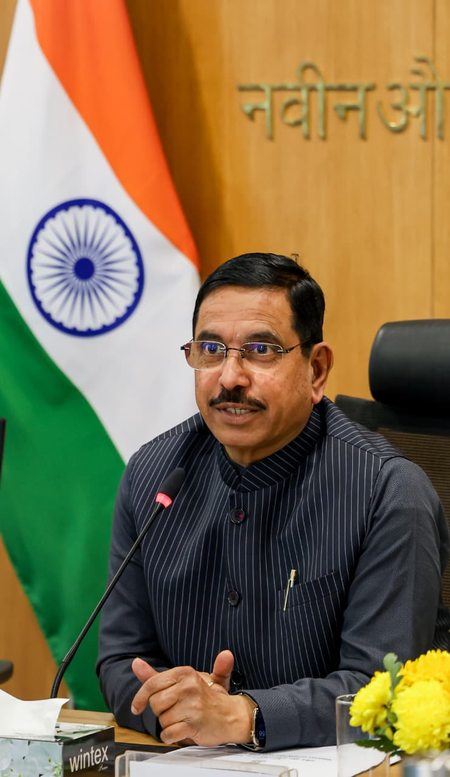
Union New and Renewable Energy Minister Pralhad Joshi announced plans to leverage artificial intelligence (AI) technologies to address persistent issues in the power sector, particularly grid congestion and renewable energy wastage. Speaking at the AI Impact Summit, Joshi highlighted the government’s focus on implementing AI-driven solutions to enhance grid stability and optimize clean energy utilization. He emphasized the need to tackle grid stability and curtailment concerns, aiming to minimize power capacity curtailment caused by grid congestion hindering renewable energy transmission.
Joshi emphasized the role of AI-based technology in efficiently managing the grid and facilitating the seamless integration of renewable energy sources. He also mentioned the decreasing costs of Battery Energy Storage Systems (BESS) due to the government’s viability gap funding (VGF) initiative. The minister projected a significant surge in India’s demand for battery storage, estimating a rise to 411 gigawatts (GW) by 2032. Notably, recent government bids have witnessed a reduction in discovered tariff rates from Rs 3.3 per unit to Rs 3.1 per unit, indicating a positive trend in battery storage pricing.
Furthermore, Joshi expressed optimism that as battery storage deployment increases, prices will further decline, akin to the substantial cost reduction observed in solar power. This downward trend in costs is expected to revolutionize the country’s energy landscape. The AI Summit also highlighted the Global Mission on AI for Energy, focusing on the convergence of solar power deployment and digital intelligence to enable real-time optimization and smarter grid management through advanced technologies. Joshi underscored the introduction of innovative digital models to enhance power distribution systems, citing examples such as the “One Solar” web application by BSES Rajdhani Power Limited and digital twin solutions for power distribution companies.
These digital initiatives are aimed at fortifying grid stability and minimizing disruptions in the power network. In a separate development, India launched a collaborative offshore wind taskforce with the United Kingdom, inaugurated by UK Deputy Prime Minister David Lammy and British High Commissioner to India Lindy Cameron.
