


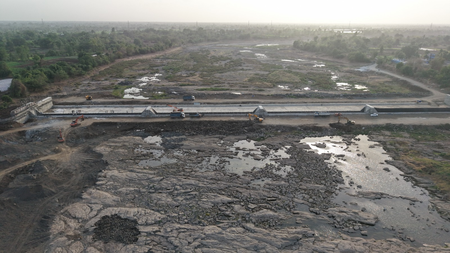
Gujarat is embarking on the construction of its initial two air-filled rubber dams employing South Korean technology to enhance irrigation, groundwater replenishment, and flood control in Chhota Udepur and Tapi districts. The projects, including the Rajvasana Rubber Dam on the Heran River in Bodeli taluka of Chhota Udepur district and the Pathakwadi Rubber Dam on the Ambika River in Dolvan taluka of Tapi district, require an investment exceeding Rs 162 crore. These initiatives align with the state’s focus on fortifying irrigation and water supply infrastructure in remote regions, in line with Prime Minister Narendra Modi’s ‘Catch the Rain’ campaign.
The Rajvasana Rubber Dam, with a cost exceeding Rs 82.97 crore, is anticipated to be finalized by September 2027 within a 30-month construction timeframe. Featuring a 180-meter-long and 3.5-meter-high inflatable rubber bladder on the Heran River, this technology is set to significantly boost the storage capacity of the existing weir, enabling it to hold 3.5 million cubic meters (MCM) of water. The project is poised to directly benefit farmers in 25 villages by providing irrigation to 3,420 hectares of agricultural land.
Officials anticipate that the increased water storage capacity will enhance groundwater levels, ensuring improved access to irrigation and drinking water in the vicinity. Notably, around 75% of the construction work has already been accomplished. The rubber dam system is designed to tackle persistent silt accumulation in the existing weir by facilitating complete removal of deposited sand and silt. During heavy rainfall periods, the inflatable structure can be deflated to allow floodwaters to flow freely, mitigating the risk of flooding in nearby villages.
As part of the project, a 900-meter flood protection wall will be erected along the left bank of the river and a 500-meter wall along the right bank. Additionally, the construction contract encompasses 10 years of operation and maintenance. The Rajvasana initiative is expected to ensure ample irrigation water for both Kharif and Rabi crops through the existing canal network, with plans to connect canals under the Rajvasana weir scheme to village ponds in the 25 beneficiary villages for storing surplus water for irrigation and drinking purposes.
The second project, the Pathakwadi Rubber Dam in Tapi district, is being developed on the Ambika River at an estimated cost of Rs 79.13 crore. This project, inspired by a Japanese design and utilizing a specialized rubber bladder imported from South Korea, aims to provide irrigation water to approximately 650 hectares of farmland. The initiative is set to benefit farmers in Pathakwadi, Dhodiyawad, Unai, and Sindhai villages by ensuring water availability for both Kharif and summer crops, with construction nearly 90% complete.
