


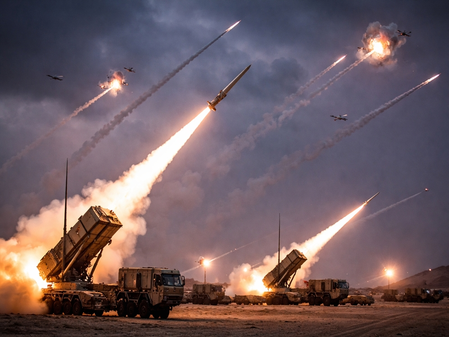
Several Gulf nations have united in defensive actions against Iranian missile and drone assaults as the conflict in the Middle East escalates. Senior US military officials revealed this development, emphasizing the regional response to Tehran’s strikes on civilian and energy infrastructure. Chairman of the Joint Chiefs of Staff Air Force General Dan Caine mentioned that US partners in the region have intercepted Iranian projectiles targeting cities and strategic facilities. Jordan, Bahrain, Saudi Arabia, the United Arab Emirates, Qatar, and Kuwait have all participated in countering Iranian aerial threats during the conflict.
The Pentagon press briefing highlighted the active involvement of these Gulf nations in intercepting Iranian attacks. For instance, Jordan successfully intercepted Iranian attack drones heading towards Amman. Bahrain also thwarted a drone targeting maritime infrastructure, safeguarding both the population and critical shipping lanes. Saudi Arabia, a significant oil producer, defended its energy facilities by intercepting missiles aimed at Dhahran. Moreover, the United Arab Emirates neutralized multiple drone attacks on industrial infrastructure in Abu Dhabi with speed and precision.
Qatar, home to a major US military base, engaged in the defensive response by shooting down two Iranian bombers en route to their location. The US officials noted that the collaborative air defense efforts reflect the Gulf states’ increasing concerns over Iranian assaults on civilian areas and economic assets. Secretary of War Pete Hegseth highlighted the region’s response to Iran’s aggression, emphasizing the cooperation with the United States as the conflict unfolds. The integrated air defense network, combining US and regional capabilities, has proven effective in intercepting Iranian missiles and drones during the ongoing conflict.
Operation Epic Fury, initiated by the United States in response to heightened tensions with Iran, has targeted Iranian missile launchers, naval assets, and military infrastructure. The conflict has expanded to encompass air, sea, and missile warfare, with Gulf states actively participating in the defense against Iranian threats. This growing involvement underscores the regional aspect of the conflict and the risks posed by Iranian missile and drone attacks to energy infrastructure and shipping routes in the Middle East.
