


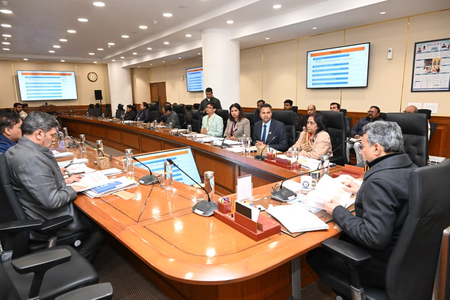
The Haryana government has started preparations for the digital Census 2027, aiming for the state’s first fully digital census. Chief Secretary Anurag Rastogi led the state-level census coordination committee’s initial meeting, focusing on administrative and logistical arrangements for the upcoming national census. To maintain data accuracy and credibility, all administrative boundaries in Haryana have been frozen until the census operations are completed.
In adherence to the Indian government’s directives, the house-listing and housing census, the first phase of Census 2027, will kick off on May 1. Deputy Commissioners will soon convene for a conference to brief Principal Census Officers on timelines and operational planning at the district level. Emphasizing the need for meticulous preparation, the Chief Secretary highlighted the significance of inter-departmental coordination and prompt decision-making for the successful execution of Census 2027.
Census Director Lalit Jain informed the committee that Census 2027 will be a significant shift as the entire process will be digital. Haryana’s technological readiness was demonstrated through a successful 100% digital pre-test using mobile applications in Panchkula, Hisar, and Faridabad, covering a population exceeding one lakh. The state’s efficient completion of the pre-test within the set timeframe earned praise from the Registrar General of India.
For the census operations, approximately 60,000 government employees, particularly teachers and other staff, will serve as enumerators and supervisors in the initial phase. The meeting also acknowledged changes in Haryana’s administrative and demographic landscape since the 2011 Census, with the state now having 23 districts compared to 21 previously. The number of sub-districts has risen from 75 to 94, while statutory towns have increased to 88 from 80, and census towns have decreased to 51 from 74. Urban agglomerations have notably grown from 12 to 20, and the number of villages currently stands at 6,523, down from 6,841 in 2011. The houselisting blocks, which were 45,361 in 2011, are projected to be around 51,000 for Census 2027.
