


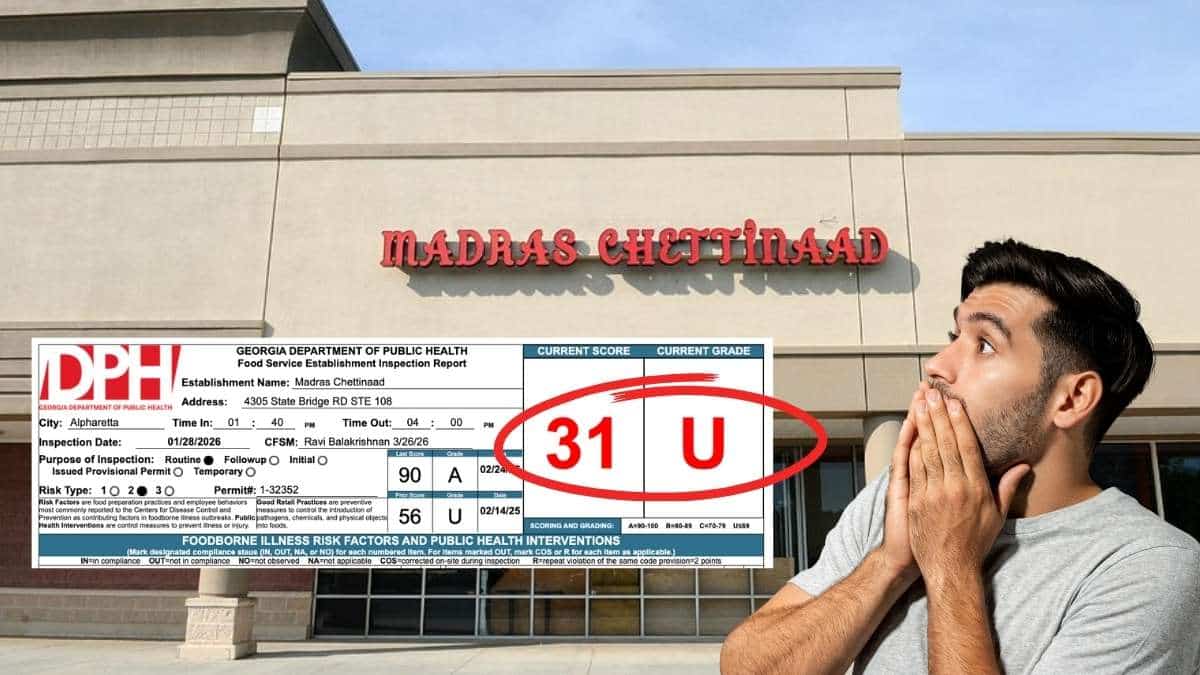
Health inspectors have flagged serious food safety risks at Madras Chettinaad, an Indian restaurant in metro Atlanta, after documenting widespread hygiene failures, unsafe food handling practices, and multiple repeat violations that pose potential risks to public health.
A routine inspection conducted by the on January 28, 2026 resulted in an unsatisfactory score of 31, a score that typically reflects systemic breakdowns rather than isolated errors.
Raw Chicken, Improper Thawing, and Cross-Contamination Risks
According to the inspection report, employees were observed prepping raw chicken and then continuing other kitchen tasks without washing their hands, creating an immediate cross-contamination risk.
Inspectors also documented raw chicken being thawed improperly, including food left at room temperature and not fully submerged under running cold water — a direct violation of food safety standards designed to prevent rapid bacterial growth.
These are among the most basic food safety rules in commercial kitchens, and violations of this nature are considered high-risk.
Food Stored Uncovered, Unlabeled, and at Unsafe Temperatures
The inspection further revealed uncovered food stored in walk-in coolers, freezers, and dry storage, along with ready-to-eat items lacking required date labels. Inspectors also found employee food stored above customer food, increasing contamination risk.
Temperature logs showed repeated failures to maintain safe holding conditions:
- Cold foods held above the 41°F limit, with some items reaching 52°F
- Hot foods held well below the required 135°F, with readings as low as 108°F
Several items were discarded during the inspection due to unsafe conditions.
Sanitation and Cleanliness Failures Across the Facility
Beyond food handling, inspectors cited grease buildup on cooking equipment, debris on food-contact surfaces, soiled wiping cloths stored in dirty sanitizer solutions, and utensils stored with handles touching food.
Multiple handwashing sinks were found without paper towels, a violation inspectors noted had occurred previously — raising concerns about whether past corrective actions were sustained.
Management and Training Gaps Identified
Perhaps most concerning, inspectors reported that the Person in Charge lacked adequate food safety knowledge and was unable to answer routine food safety questions. Several employees had not reviewed or signed required employee health reporting agreements, despite this being cited as a repeat violation.
Taken together, inspectors characterized the issues as indicative of training, supervision, and management failures, not momentary lapses.
A Broader Pattern Emerging
This inspection does not exist in isolation.
Other Indian restaurants in the Alpharetta, Suwanee, Cumming region have recently received unsatisfactory inspection results, including:
When similar violations appear repeatedly across different establishments, it points to a broader quality-control problem that the industry can no longer afford to dismiss.
The Urgent Need for Higher Quality Expectations
Indian cuisine is among the most celebrated in the world — but authentic flavors do not excuse unsafe kitchens.
Restaurant owners must invest in serious food safety training, enforce strict internal checks, and adopt zero tolerance for repeat violations. Regulators, diners, and community voices all play a role in demanding higher standards.
Public health is not optional.
Amit Gupta, Founder of Indian.Community expressed serious concern over the growing number of such incidents, emphasizing that this is no longer about one restaurant or one inspection.

“When we repeatedly see unsafe food handling, hygiene lapses, and management failures, it becomes a community issue — not just a regulatory one,” said . “Indian cuisine is deeply respected and loved, but that reputation can erode quickly if health and quality are not treated as non-negotiable. As a community, we need to come together — restaurant owners, staff, and diners alike — to ensure safety, cleanliness, and accountability are prioritized every single day. There is no excuse when public health is at stake.”
Mr. Gupta added that transparency, higher internal standards, and zero tolerance for repeat violations are essential to protecting both diners and the long-term credibility of Indian restaurants across the U.S.
Share Your Experience
Have you dined at Madras Chettinaad or the other restaurants mentioned above?
Did your experience align with what inspectors found — or was it different?
We invite readers to share their experiences in the comments below. Transparency and accountability begin with informed voices.
