


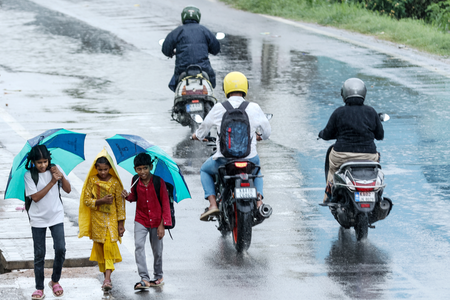
Bengaluru, Aug 3 (IANS) Even as Karnataka remains locked in a dispute over the sharing of Cauvery river water with Tamil Nadu, the state is witnessing a striking weather contrast. While incessant rainfall has lashed the Cauvery catchment and the Western Ghats, rapidly filling major reservoirs and triggering floods and landslides, vast stretches of North Karnataka continue to reel under a severe rain deficit, leaving crops parched and farmers in distress.
Heavy rains in the Cauvery basin have significantly increased inflows into major reservoirs. The Krishna Raja Sagar (KRS) dam, which has a maximum level of 124.80 feet, recorded a water level of 100.34 feet on Monday. The Kabini reservoir, with a full reservoir level of 2,284 feet, has risen to 2,282.13 feet, while the Hemavathi dam has reached 2,910 feet against its maximum capacity of 2,922 feet.
Other major reservoirs across the state have also registered a sharp rise in water levels. The Linganamakki dam stood at 1,781.85 feet against its maximum level of 1,819 feet. The Almatti dam touched its full reservoir level of 518.96 metres, while the Narayanapura dam reached 491.42 metres against its maximum capacity of 492.25 metres. The Bhadra reservoir recorded a water level of 160.3 feet against its full level of 186 feet, while the Tunga dam stood at 587.36 metres against its maximum level of 588.24 metres.
The heavy rainfall has disrupted normal life across several districts. The state government declared a holiday for schools and colleges in Shivamogga, Mangaluru and four other districts as a precautionary measure.
Madikeri district, where the Cauvery originates at Talakaveri, has been among the worst affected. Continuous rainfall has thrown normal life out of gear, with rivers and streams in spate.
In Shivamogga district, rising water levels in the Tunga river have created a flood threat in Megaravalli. As many as 23 families living along the riverbank have been shifted to the Ambedkar Bhavan relief centre as a precautionary measure.
In Sakleshpur of Hassan district, landslides triggered by heavy rain have disrupted railway operations, with efforts to clear soil and debris from railway tracks hampered by continuing showers.
The release of water from the Kabini reservoir has submerged several low-lying bridges, affecting connectivity in nearby areas. In Raichur district, a temple has also been inundated following heavy rainfall.
In Belagavi district, the Markandeya river has crossed the danger mark, inundating hundreds of acres of agricultural land in Kadoli and Ambewadi villages. Vast stretches of sugarcane and paddy fields, extending nearly half a kilometre to one kilometre along the riverbank, have gone under water. The bridge connecting Khanapura and Matungra, built across the Malaprabha river, has also been submerged.
Search operations are continuing for Jeevan Pinto, who was washed away in floodwaters at Raayi village in Bantwal taluk of Mangaluru district on Sunday. Personnel of the National Disaster Response Force (NDRF) resumed the search operation on Monday.
Heavy rainfall has also affected Chikkamagaluru district, where coffee, arecanut, banana and cardamom plantations have suffered widespread inundation.
However, while southern and Malnad districts struggle with excess rainfall, several parts of North Karnataka continue to face an alarming drought situation.
Farmers in Bagalkot and Koppal districts said standing crops are drying up due to the prolonged absence of rain. Leaves have turned yellow, raising fears of large-scale crop losses. Although nearly four lakh hectares are normally brought under cultivation during the season, only around two lakh hectares have been sown this year due to failure of Monsoon rains, and even those crops are under severe stress.
The situation is equally grim in Raichur district, where monsoon rains have largely failed. Farmers who invested between Rs 3 lakh and Rs 4 lakh in sowing crops are staring at heavy losses and mounting debt. Many have begun migrating to Mumbai, Hyderabad, Bengaluru and other cities in search of work. Local residents said nearly 60,000 farmers migrate every year, but the number is expected to be much higher this season. Tur dal, the district’s principal crop, has dried up almost completely due to the lack of rainfall.
Residents in the drought-hit districts have also reported an acute drinking water crisis, with severe shortages affecting both people and livestock, highlighting the stark contrast between flood-hit southern Karnataka and the parched northern regions of the state.
–IANS
mka/rad
