


The Indian Institute of Technology Madras unveiled ANCHOR (Atlas of Neurochemical Characterisation of the human brainstem with 3D Reconstruction), described as the world’s most intricate three-dimensional atlas of the human brainstem. Developed by the Sudha Gopalakrishnan Brain Centre, ANCHOR offers comprehensive 3D maps of the human brainstem from prenatal stages to adulthood, aiding researchers, clinicians, and patients globally.
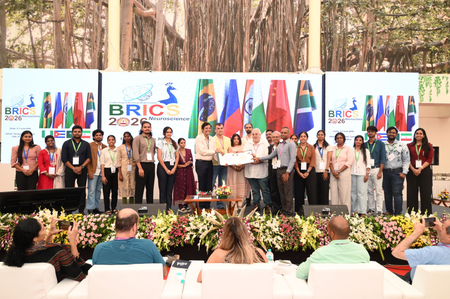
This detailed atlas, ANCHOR, includes over 200 brainstem nuclei and fiber tracts reconstructed from hundreds of serial sections, utilizing eight immunostains overlaid across more than 500 sections for precise mapping. Released during the 3rd BRICS Neuroscience Symposium at IIT Madras, the atlas is accessible through a website to facilitate advanced research in neurobiology.
The Sudha Gopalakrishnan Brain Centre aims to create a comprehensive collection of human brain maps at the cellular level, covering various life stages and neurological conditions. With a team of over 200 researchers, engineers, and technicians collaborating with 20 partners worldwide, the center is dedicated to imaging more than 100 whole brains to advance the understanding of brain structure and function.
Prof. Ajay Kumar Sood, the Principal Scientific Adviser to the Government of India, hailed this achievement as a significant milestone in neurobiology. He emphasized the importance of these detailed maps in identifying specific cell populations affected by brain stem lesions, crucial for clinical applications. The center’s innovative approach, combining MRI, histology, and chemo-architecture, represents a major leap in brain sciences.
