


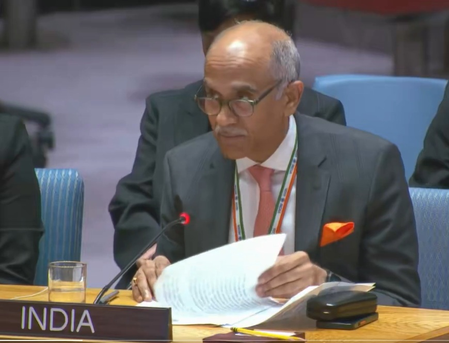
India has accused Pakistan of operating an “organised factory of hate” that uses religious language to foster lasting animosity towards India among its populace, allegedly to help Pakistan’s “deep state” maintain power. India’s Permanent Representative P Harish criticized Pakistan at the Security Council, stating that blaming neighbors for its own failures is a common Pakistani practice and that this strategy will not succeed. Pakistan’s directive to label groups within its borders as “Fitna al Hindustan” was described as state-sponsored misinformation by Harish.
Harish highlighted that the term “Fitna” in Arabic can mean “sedition” or “idolatry.” He emphasized that Pakistan’s deep state aims to perpetuate hostility towards India among its citizens to ensure its grip on power and divert attention from internal issues. Referring to the military as the “deep state,” Harish pointed out how recent constitutional amendments solidified military control over Pakistan’s governance.
The 27th Constitutional amendment in November elevated military chief Field Marshal Asim Munir, granting him significant authority and reinforcing military dominance over the government. During a Security Council discussion on Afghanistan, Harish urged global cooperation to combat terrorism linked to Pakistan. He stressed that coordinated international action is necessary to prevent groups like ISIL, Al Qaida, Lashkar-e-Tayyiba (LeT), Jaish-e-Mohammed, and LeT proxies such as The Resistance Front from engaging in cross-border terrorism.
The Resistance Front, a LeT proxy, claimed responsibility for a religiously motivated attack in Pahalgam last April, resulting in the deaths of 24 Hindus and a Christian.
