


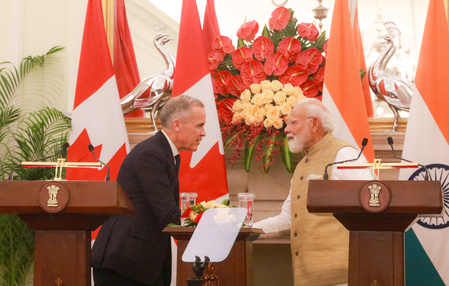
India and Canada are set to establish a Strategic Energy Partnership following Prime Minister Mark Carney’s visit to New Delhi. This partnership aims to translate climate diplomacy into tangible infrastructure developments in areas such as solar, hydrogen, wind, and low-carbon LNG. India has committed to achieving 500 GW of non-fossil power capacity by 2030, necessitating the addition of 40-50 GW of clean capacity annually for the next decade, significantly surpassing historical averages.
During Carney’s visit, both countries unveiled a Strategic Energy Partnership encompassing LNG, LPG, uranium, solar, hydrogen, and critical minerals. This collaboration is supported by commercial agreements valued at over $5.5 billion Canadian dollars. Canada also pledged to join the International Solar Alliance led by India and France, along with upgrading to full membership in the Global Biofuels Alliance, aligning with India’s preferred multilateral clean energy initiatives.
Furthermore, a memorandum of understanding (MoU) focusing on clean energy cooperation was signed, outlining joint efforts in solar, wind, bioenergy, small hydro, storage, and capacity-building. Canada is positioning itself as a reliable supplier of low-carbon LNG, uranium, and critical minerals, while also supporting India’s grid expansion and storage requirements to meet its substantial energy demands.
Acknowledging India’s plan to increase the share of LNG in its primary energy mix by 2030 and add 500 GW of clean capacity, Canada aims to produce approximately 50 million tonnes of LNG annually by 2030, with India as a key market. The partnership emphasizes transitioning from coal to lower-carbon gas, providing stable power to complement intermittent renewables.
The success of this collaboration will be contingent on clearly limiting and time-bounding gas as a transitional fuel, alongside concurrent investments in technologies that will eventually replace it. Beyond individual deals, the partnership signifies a broader ecosystem of collaboration between Canada and India in clean energy technologies, critical minerals, and forward-looking industries.
As India transitions towards substantial non-fossil fuel capacity additions, the focus shifts from pilot projects to the development of project pipelines. To achieve the annual target of 40-50 GW of non-fossil capacity, India requires consistent auction schedules, pre-generation grid infrastructure, and concessional finance to reduce renewable and storage capital costs.
Canada’s effectiveness in this partnership will be measured by the extent to which its financial institutions support large-scale solar, wind, storage, and transmission projects, not solely LNG and uranium ventures. The Strategic Energy Partnership’s potential lies in fostering joint solar manufacturing zones, battery supply chains, grid-balancing initiatives, and resilient critical mineral supply chains, marking a pivotal moment in India-Canada energy relations.
