


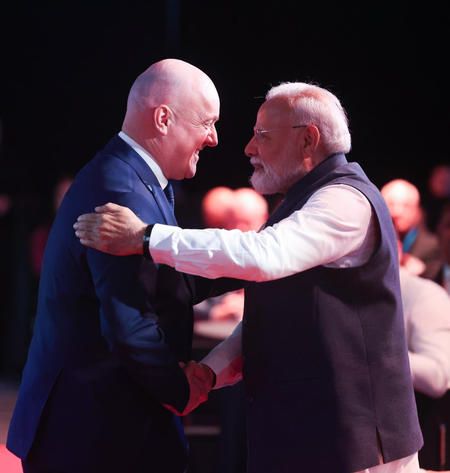
India and New Zealand have announced the formation of a Strategic Partnership and introduced a detailed ‘India-New Zealand Strategic Partnership: Roadmap to 2030’ aimed at enhancing collaboration in various key areas. Prime Minister Narendra Modi and New Zealand Prime Minister Christopher Luxon met in Auckland to endorse this roadmap as a mutual framework to bolster bilateral relations. The roadmap encompasses six main pillars covering political engagement, defense and security cooperation, trade and economic partnership, people-to-people links, education and innovation, and regional and multilateral cooperation.
The Strategic Partnership roadmap emphasizes the commitment of both nations to engage in regular high-level interactions, including meetings between Prime Ministers, Cabinet Ministers, and senior officials. It also includes plans to strengthen the Foreign Ministers’ Dialogue, parliamentary exchanges, and annual Secretary-level consultations between the Ministries of External Affairs of both countries to oversee the partnership’s implementation. In the defense and security sector, India and New Zealand have agreed to expand cooperation through various means such as military exercises, visits of maritime, air, and land units, personnel exchanges, and high-level defense dialogues.
Furthermore, the roadmap outlines initiatives to enhance maritime security cooperation under the Indo-Pacific Oceans Initiative, establish an annual Maritime Security Dialogue, operationalize a Joint Working Group on Counter-Terrorism, and deepen collaboration on cybersecurity. Both countries are also committed to combatting drug trafficking and enhancing law enforcement cooperation between India’s National Investigation Agency and New Zealand Police. Additionally, they aim to double bilateral trade in goods and services to NZ$7 billion by 2030 and work towards the early implementation of the India-New Zealand Free Trade Agreement.
In the primary industries sector, the focus will be on strengthening cooperation in areas such as horticulture, forestry, animal husbandry, and dairying. The roadmap also includes provisions to promote joint research, technical exchanges, innovation, and market development in these sectors. The partnership will also see expanded tourism cooperation, implementation of the Tourism Memorandum of Arrangement, and efforts to boost two-way visitor flows through direct non-stop flights.
