


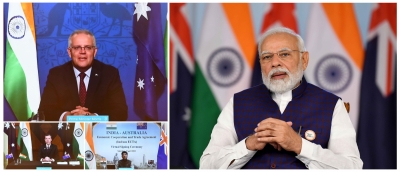
The India-Australia Economic Cooperation and Trade Agreement (Ind-Aus ECTA) marked its fourth anniversary on Thursday, playing a crucial role in increasing India’s exports and fostering trade between the two nations. Since its inception on April 2, 2022, the agreement has opened up new avenues for businesses, entrepreneurs, and job opportunities in both countries. India’s exports to Australia have more than doubled, surging from $4 billion in FY 2020–21 to $8.5 billion in FY 2024–25.
Total bilateral trade between India and Australia reached $24.1 billion in 2024–25, with Indian exports to Australia experiencing an 8% growth compared to the previous year. By February 2025–26, the total trade between the two countries amounted to $19.3 billion, as per data released by the Commerce Ministry. Under the India–Australia ECTA, India provided preferential market access on 70.3% of its tariff lines, encompassing 90.6% of trade value, while Australia granted similar access to 100% of imports from India.
The agreement saw 98.3% of tariff lines becoming duty-free immediately upon implementation, with the remaining 1.7% (113 tariff lines) set to phase out over five years. Starting January 1, 2026, all Indian exports will enjoy zero-duty market access into Australia. Noteworthy sectoral gains under the ECTA include significant export growth in textiles, pharmaceuticals, chemicals, and agricultural products. On the import front, the agreement has facilitated the procurement of essential raw materials like base metals, raw cotton, chemicals, fertilizers, and pulses, crucial for India’s manufacturing and industrial sectors.
A significant milestone in bilateral cooperation was reached with the Mutual Recognition Arrangement (MRA) on Organic Products signed between India and Australia on September 24, 2025. This arrangement streamlines trade in organic products by acknowledging each other’s certification systems, reducing duplication, costs, and time for exporters. Strengthening cooperation in the organic sector, the MRA enhances transparency and trust in organic trade practices. The agreement stands as a cornerstone of bilateral engagement, delivering tangible benefits for businesses, MSMEs, workers, and consumers in both nations.
