


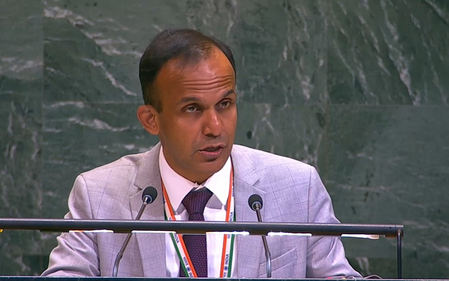
India has urged for the cessation of economic embargoes and sanctions, labeling them as hindrances to economic and social progress and violations of national sovereignty. Emphasizing its commitment to multilateralism, India’s representative at the UN, Eldos Mathew Punnoose, highlighted the adverse impact of embargoes and sanctions on human rights, including the rights to development, food, education, and healthcare.
Punnoose stressed the detrimental effects of such measures on the populations of affected countries, particularly women and children, and advocated for their removal to enable full economic and social development. He referenced the General Assembly’s call for nations to refrain from imposing laws with extraterritorial effects that impinge on the sovereignty of other states.
Addressing the annual discussion at the Assembly, Punnoose specifically mentioned the enduring US embargo on Cuba and reiterated India’s stance against unilateral sanctions. He underscored that only the UN Security Council has the authority to impose embargoes and sanctions, emphasizing that unilateral measures are inconsistent with international law and the UN Charter.
India’s representative highlighted Cuba’s contributions to global healthcare despite the embargo, emphasizing the need to recognize and support such efforts. He pointed out the historical context of the US embargo on Cuba, which has evolved over the years, with recent intensification under the Trump administration’s maximum pressure approach.
US Permanent Representative Mike Waltz countered claims of a blockade or embargo on Cuba, citing international aid received by the country. He emphasized ongoing US assistance to Cuba, including aid and collaboration with humanitarian organizations. The debate at the UN reflects ongoing global discussions on the impact and legitimacy of economic embargoes and sanctions.
