


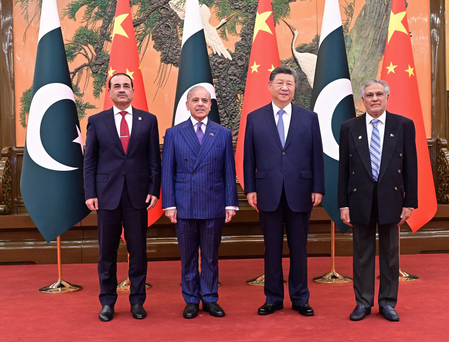
India expressed strong disapproval of the inclusion of references to the Indian Union Territory of Jammu and Kashmir in a Joint Statement issued by China and Pakistan after a meeting between their leaders in Beijing. The Ministry of External Affairs spokesperson, Randhir Jaiswal, emphasized that no other country has the authority to comment on the status of Jammu and Kashmir. India reiterated its firm stance that Jammu and Kashmir and Ladakh are integral parts of India and will always remain so.
In a meeting with Pakistani Prime Minister Shehbaz Sharif, Chinese President Xi Jinping discussed enhancing the China-Pakistan relationship for a “shared future.” Additionally, Pakistan’s Chief of Army Staff, Asim Munir, assured Chinese Foreign Minister Wang Yi of Pakistan’s commitment to furthering the China-Pakistan community and the China-Pakistan Economic Corridor (CPEC). India has consistently opposed the CPEC, considering it a project that infringes on its sovereignty and territorial integrity.
India has strongly objected to the CPEC projects, some of which are located in Indian territory, as they violate India’s sovereignty. The Ministry of External Affairs reiterated its rejection of any attempts by other nations to support Pakistan’s occupation of these territories. India has also raised concerns about the so-called ‘trans-boundary water resources cooperation’ between China and Pakistan, emphasizing that as the two countries do not share a border, such cooperation is not valid. India has never accepted the 1963 boundary agreement between Pakistan and China.
