


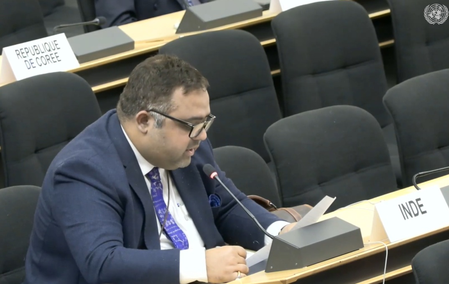
India has rejected a report by the UN expert on minority issues, calling it “factually incorrect” and showing “hostility” towards the country. Gaurav Kumar Thakur, a counselor at India’s UN Mission in Geneva, stated that India disputes the claims made by Nicolas Levrat, the special rapporteur on minority issues, regarding the Waqf Amendment Act 2025. Thakur emphasized that Levrat’s assertions are based on a flawed understanding of the law’s background and history.
Thakur, speaking at a session of the Human Rights Council in Geneva, criticized the tone and content of Levrat’s remarks, noting a perceived bias against India. The special rapporteurs of the Council are independent experts who report on assigned issues in their personal capacity, despite appearing to represent the Council’s views. Thakur highlighted that Levrat’s comments seem to exhibit a clear bias against India.
According to Levrat’s report, the Waqf Amendment Act allegedly limits Muslim communities’ ability to own and manage places of worship. Thakur, however, defended the law, stating that its purpose is progressive, aiming to enhance transparency, gender equality, and efficient administration. He pointed out that the legislation empowers minority Muslim sects such as Bohras and Agakhanis by safeguarding their right to establish and maintain their worship places.
Thakur accused Levrat of relying on biased sources to formulate his opinions, alleging that certain organizations aim to spread misinformation and tarnish India’s diverse culture for political gain. Thakur reiterated India’s commitment to empowering ethnic, religious, and linguistic minorities while preserving the nation’s pluralistic ethos. He emphasized that India’s democratic principles and Constitution ensure fundamental rights for all citizens, including specific protections for minorities to safeguard their identities.
The Waqf Amendment Act includes provisions to uphold women’s rights and ensure representation of all Muslim sects in the bodies governing Muslim charitable endowments. The law mandates the inclusion of at least two Muslim women on the Central Waqf Council and State Waqf Boards, along with provisions for female inheritance rights. Additionally, the amendment requires representation from various Muslim sects on State Waqf Boards, underscoring inclusivity and diversity.
