


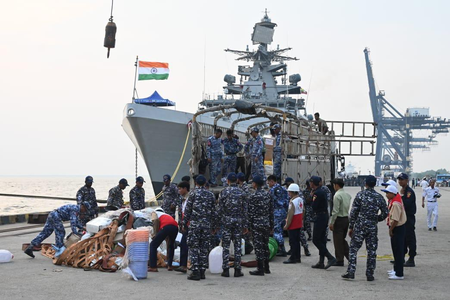
India has become a crucial partner for the Association of Southeast Asian Nations (ASEAN) by offering support in critical areas during disasters without seeking dependency, a report highlighted. The country’s swift humanitarian aid during major calamities in Southeast Asia has been noted, such as the launch of ‘Operation Sadbhav’ to assist Vietnam, Laos, and Myanmar after Typhoon Yagi hit in 2024. Additionally, India was among the first responders to the 7.7-magnitude earthquake in Myanmar, initiating ‘Operation Brahma’ that provided medical care to over 2,500 patients.
These rapid response operations have reshaped how the region views India, with a survey by the ISEAS–Yusof Ishak Institute ranking India as a rising partner in Southeast Asia. The report emphasized that India is increasingly seen as a practical security provider rather than a contender for regional leadership. Unlike other major powers in the region, India’s assistance comes without the burden of alliance politics or territorial disputes, making it a valuable and non-intrusive partner for ASEAN nations.
The report also pointed out that Southeast Asia, despite being offered help by various external powers, often faces challenges related to the conditions attached to such aid. While the United States and China bring capabilities and resources, they also come with political entanglements and strategic interests that may not align with the region’s preferences. In contrast, India’s assistance is characterized by its understated yet impactful presence, offering security support without imposing any strategic obligations on ASEAN states.
According to the ISEAS–Yusof Ishak Institute’s 2025 State of Southeast Asia survey, India’s strategic significance to ASEAN has risen significantly, moving from the ninth to the sixth position within a year. The survey also identified India as a preferred partner for Southeast Asian nations looking to diversify their alliances and navigate the US-China rivalry, highlighting India’s growing role as a trusted partner for capacity-building initiatives.
