


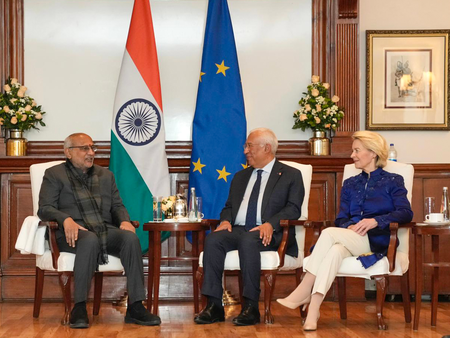
The India-European Union free trade agreement (FTA) signifies a mutual understanding that extends beyond mere trade, addressing the challenges of “weaponised interdependence.” According to a report by Euronews, the deal transcends tariffs, especially in a time where major powers are weaponizing tariffs and exploiting supply-chain dependencies.
The agreement underscores the importance for “middle powers” to bolster resilience collectively while upholding shared values. It highlights India’s commitment to enhancing its manufacturing and services sectors without compromising its political neutrality.
In order for the agreement to materialize effectively, the report suggests that Europe needs to monitor progress through measurable milestones, focusing on market access, collaboration in energy and industry transitions, and advancements in technology and supply-chain partnerships. It emphasizes the necessity for cooperation at both the organizational and industry levels to maximize the FTA’s potential.
The FTA entails a significant reduction or elimination of tariffs on 97% of EU goods exported to India and grants preferential access for 99% of Indian exports by value. Noteworthy concessions were made, with European car tariffs remaining at 40% and India committing to gradually remove duties on key industrial products.
Europe faces mounting pressure to diversify its economic relationships, and the FTA is viewed as a promising step towards establishing more strategic alliances in the coming year. The EU-India Trade and Technology Council is actively engaged in initiatives related to semiconductors, digital infrastructure interoperability, and other key areas.
The report advocates for the FTA to pave the way for trusted supplier networks and collaborative research and development pathways. Enhanced cooperation in artificial intelligence (AI) and secure data sharing could offer alternatives to the dominant AI approaches of the US and China.
