


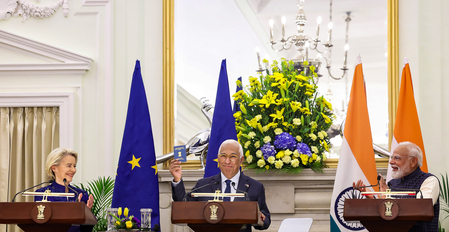
The Federation of Indian Export Organisations highlighted the significance of the India-EU free trade agreement, along with recent FTAs with the UK and EFTA, in granting Indian exporters access to the entire European market. The EU agreement covers various aspects like trade in goods and services, rules of origin, customs facilitation, trade remedies, and emerging areas such as digital trade and MSMEs. It also includes mechanisms to address non-tariff barriers through regulatory cooperation and transparent SPS measures.
SC Ralhan, President of FIEO, mentioned that the agreement’s liberalization in the automobile sector will enable EU manufacturers to introduce advanced models in India, aligning with the ‘Make in India’ and ‘Atmanirbhar Bharat’ initiatives. India and the European Union have a substantial bilateral trade relationship, with trade in goods reaching Rs 11.5 lakh crore ($136.54 billion) in FY 2024–25, and trade in services at Rs 7.2 lakh crore ($83.10 billion).
The successful conclusion of the India-EU FTA is expected to boost India’s export competitiveness and strengthen its integration into global value chains. This agreement offers extensive market access for Indian exporters, particularly benefiting labor-intensive sectors, MSMEs, women entrepreneurs, artisans, and youth, aligning with the government’s inclusive growth agenda. With tariff elimination on a significant portion of Indian exports, key sectors like textiles, apparel, leather, gems and jewelry, and automobiles are poised to gain immediate benefits.
The FTA is projected to lead to increased exports, job creation, and enhanced participation in global trade, supporting the government’s goal of export-led prosperity. Indian consumers are anticipated to gain access to high-technology products and increased competition, while agriculture and processed food exports are set to receive a substantial boost. Sensitive sectors like dairy and cereals have been safeguarded, ensuring the protection of farmer interests.
