


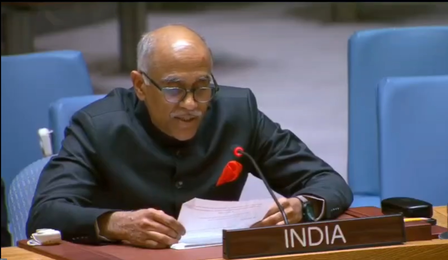
India has raised worries about the rise of platforms operating in parallel to the United Nations, attempting to handle peace and security matters while the Security Council faces deadlock. India’s Permanent Representative P. Harish highlighted the shift of security discussions to alternative frameworks, some involving private sector entities, to address peace and security issues outside the UN. Secretary-General Antonio Guterres emphasized that no organization or ad-hoc coalition can supersede the Security Council’s authority.
Guterres stressed that only the Security Council possesses the mandate to make universally binding decisions on peace and security, including the authorization of the use of force under international law. He underscored the necessity for Council reform to enhance its representation and effectiveness promptly. The references made by Guterres and Harish to “ad hoc coalition” and “parallel plurilateral frameworks” were indirectly linked to the Board of Peace initiated by US President Donald Trump, perceived as a challenge to the UN’s role.
Trump’s creation of the Board of Peace, intended to oversee Gaza’s reconstruction, has garnered attention. Despite Trump’s assurance of collaboration with the UN, his statements hint at a reduced role for the UN in enforcing international peace and security. The Board, comprising 22 members, including Pakistan, has been offered “permanent” membership for substantial contributions. Harish stressed the urgency of Council reform and the addition of permanent members to uphold international rule of law amid the UN’s current challenges.
