


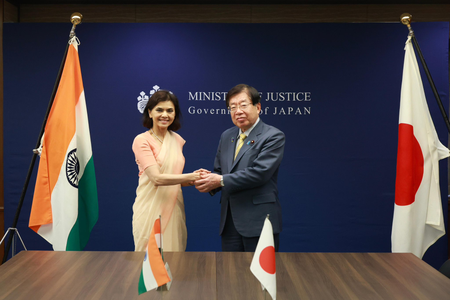
India and Japan recently engaged in discussions to enhance people-to-people exchanges and address mutual interests. The meeting involved India’s Ambassador to Japan, Nagma Mallick, and Japan’s Minister of Justice, Hiroshi Hiraguchi. They explored various topics, including the India-Japan Action Plan on Human Resource Exchange and Cooperation.
Furthermore, on May 11, both countries conducted the second round of the Economic Security Dialogue in New Delhi. During this dialogue, they agreed to strengthen collaboration in strategic industrial sectors to bolster supply chain resilience. Foreign Secretary Vikram Misri and Japanese officials co-chaired this event, emphasizing the importance of deepening ties in key industrial areas.
In the meeting, officials from India and Japan exchanged views on economic security challenges faced by both nations. They highlighted concerns such as economic coercion, non-market policies, and overproduction, along with their respective economic security strategies. The discussions also touched upon the Japan-India Private Sector Economic Security Dialogue and policy recommendations aligned with the priorities outlined in the Japan-India Joint Statement from the previous year.
Additionally, the two countries conducted the Japan-India Foreign Vice-Ministers’ Dialogue, focusing on regional situations in the Indo-Pacific and the Middle East, including developments in Iran. Both sides agreed to collaborate on ensuring energy and resource supplies and enhancing the resilience of critical goods supply chains, particularly in light of the current Middle East scenario.
To further strengthen their relationship, India and Japan are committed to building a comprehensive partnership across various sectors based on the ‘Japan-India Joint Vision for the Next Decade.’ This vision, announced during Prime Minister Modi’s visit to Japan, emphasizes accelerating cooperation in economic growth through investment, innovation, and economic security, with a strong emphasis on public-private collaboration.
