


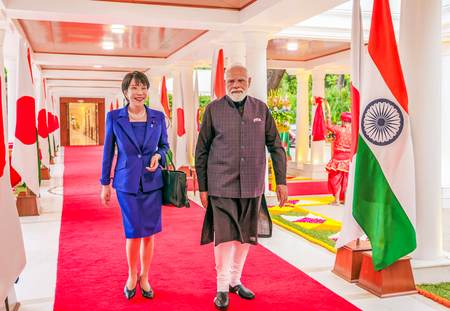
The recent India-Japan annual summit showcased a shift from traditional economic cooperation to a comprehensive strategic partnership. Prime Minister Narendra Modi and Japanese Prime Minister Sanae Takaichi discussed various aspects of their bilateral relationship, including trade, investment, defense, and regional cooperation. The summit emphasized regional stability, democratic alliances, and a joint stance against coercive actions in the Asia-Pacific region.
The leaders exchanged Memoranda of Understanding on economic security, clean energy, critical technologies, and research and development, highlighting the depth of their collaboration. The summit’s strategic significance was underscored by Prime Minister Takaichi’s remarks on the security challenges in the East and South China Sea, signaling a united front against attempts to alter the regional status quo through force.
Both Prime Ministers reaffirmed their commitment to upholding freedom of navigation and resolving maritime disputes peacefully in accordance with international law. They also agreed to enhance cooperation on maritime security, intelligence sharing, and defense technology to counter coercive behavior in the Indo-Pacific region. This joint approach sends a strong message against unilateral actions that threaten regional stability.
In addition to security cooperation, the summit focused on economic security issues, with both countries expressing concerns about economic coercion and supply chain disruptions. India and Japan decided to bolster cooperation in critical minerals, semiconductors, Artificial Intelligence (AI), and energy resilience to reduce dependence on China and build resilient regional value chains. The alignment of their strategic visions and enhanced defense engagements signifies a more balanced Indo-Pacific architecture.
