


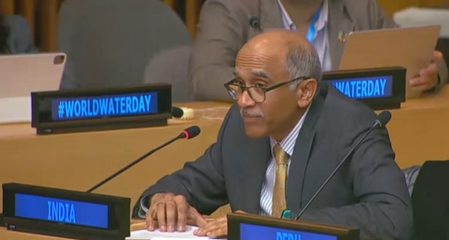
India has restated its stance that the Indus Waters Treaty (IWT) will be suspended until Pakistan, described as the “global epicentre of terror,” changes its behavior. India’s Permanent Representative P Harish emphasized the need for Pakistan to prioritize human life over treaty obligations during a UN event marking World Water Day. India, as an upper riparian state, has historically acted responsibly, but demands reciprocal responsibility from Pakistan, urging it to renounce terrorism as a state policy.
Harish addressed Pakistan’s attempt to portray itself as a victim regarding the IWT during a UN event focusing on ensuring access to safe water and sanitation for all as part of the UN Sustainable Development Goal. India, having signed the IWT in 1960 in good faith, accuses Pakistan of breaching the treaty’s spirit through wars and numerous terror attacks. The decision to suspend the treaty came after a terrorist incident in Pahalgam last year, attributed to The Resistance Front, linked to Lashkar-e-Tayiba, a Pakistan-backed group.
India’s patience wore thin due to Pakistan’s continued support for terrorism, leading to the announcement of the IWT’s suspension until Pakistan unequivocally ends its backing of all forms of terrorism. India also highlighted the necessity of revising the treaty to reflect changes over the past 65 years, including technological advancements and demographic shifts, which Pakistan has been unwilling to discuss. Efforts to engage Pakistan in treaty modifications were met with refusal, according to Harish.
In line with the World Water Day theme, India emphasized its commitment to achieving universal access to safe water and sanitation through initiatives like the Jal Jeevan Mission. Launched in 2019, this program has already provided piped drinking water to 81.76% of rural households, benefiting a total of 158 million people. Community involvement, particularly through women-led village water committees, plays a crucial role in planning, monitoring, and maintaining local water systems. Harish underscored the importance of collective efforts at the UN, focusing on areas of common interest such as enhancing national capacities, fostering technological innovation, and promoting scientific cooperation.
