


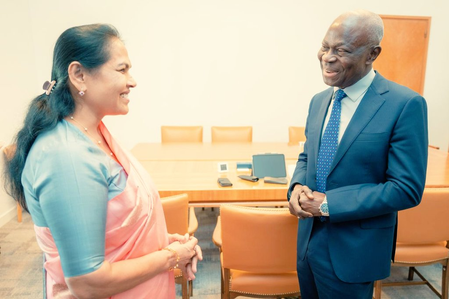
India has restated its dedication to collaborating closely with the International Labour Organisation (ILO), governments, employers’ and workers’ organizations, and other stakeholders to advance the goals of the Global Coalition for Social Justice (GCSJ), as per an official statement on Friday.
Minister of State for Labour and Employment Shobha Karandlaje led the Indian delegation at the 114th International Labour Conference (ILC) in Geneva, Switzerland. She engaged in the Coordination Group Meeting of the GCSJ during the event.
During the meeting, Karandlaje held discussions with Gilbert F. Houngbo, Director-General of ILO, Labour Ministers from various countries, and other esteemed partners, according to the Labour Ministry.
India expressed eagerness to actively contribute to the Coalition’s future endeavors by advocating for inclusive growth, reinforcing social protection systems, backing responsible business practices, and promoting international cooperation for fair and resilient labor markets, the statement mentioned.
The Global Coalition for Social Justice, founded in 2023 by the ILO, serves as a multi-stakeholder platform aimed at enhancing multilateral cooperation and translating political commitments into tangible results.
By uniting a diverse array of partners, the Coalition plays a pivotal role in improving coherence, coordination, and effectiveness across the multilateral system.
India has implemented extensive labor reforms guided by the principle of “Antyodaya,” consolidating 29 Central Labor Laws into four Labor Codes to streamline compliance, enhance workers’ welfare, and establish a modern and transparent labor environment.
Youth employability in India has risen from 34% in 2014 to over 56% in 2025. The unemployment rate dropped from 6% to 3.1% between 2017 and 2025, while women’s workforce participation surged from 22% to 38.8%.
Previously, she briefed the ILO Director-General on the expansion of India’s social protection coverage, which, according to preliminary ILO estimates, now benefits 68.4% of the total population, equivalent to 1,001 million beneficiaries.
