


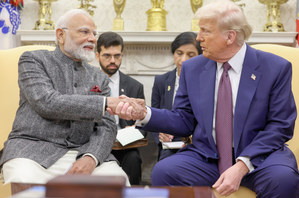
Although full details are yet to emerge, the interim India-US trade deal framework suggests that India has secured the ‘best deal’ from the United States compared to neighboring countries. This trade agreement aims to enhance the collaboration between the two large democracies, offering significant opportunities for farmers, MSMEs, entrepreneurs, and skilled workers.
The uniform 18 per cent rate provided to India gives it a competitive edge over many countries in its vicinity and the broader region. This rate is advantageous compared to the tariffs faced by exporters from other nations, granting India more predictable access to the US market.
Furthermore, the 18 per cent rate helps India bridge the gap with Europe, which currently faces a 15 per cent tariff. The tariffs imposed by the US on Indian goods are comparable to those on goods from its closest allies, such as the United Kingdom, the European Union, Switzerland, Japan, and South Korea.
The reduced tariff difference enhances the pricing competitiveness of Indian products, benefiting exporters in sectors like textiles, apparel, leather goods, chemicals, and engineering items. This framework not only strengthens India’s position against regional competitors but also paves the way for the removal of tariffs on a wide range of Indian products.
Moreover, the lowered US tariffs on Indian goods position India favorably compared to most ASEAN peers and China. This development is seen as a positive step for India’s real economy, exports, sentiments, and financial markets, according to DBS Group Research Senior Economist Radhika Rao. Industries like textiles, gems and jewelry, engineering goods, leather, and chemicals are expected to be among the immediate beneficiaries.
India now enjoys one of the lowest tariff rates imposed by the Donald Trump administration compared to other Asian economies like China, Pakistan, Indonesia, Bangladesh, and Vietnam.
