


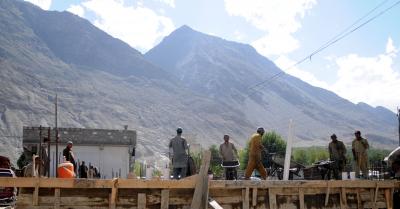
India has rejected the Chinese infrastructure development in the Shaksgam Valley in Pakistan-occupied Kashmir, emphasizing its right to protect its interests in the region. The Ministry of External Affairs spokesperson, Randhir Jaiswal, reiterated India’s non-acceptance of the China-Pakistan Boundary Agreement of 1963, which aimed to transfer the area to China unlawfully. India also does not recognize the China-Pakistan Economic Corridor (CPEC) passing through Indian territory under Pakistan’s illegal occupation.
The Ministry of External Affairs stated that Jammu and Kashmir, along with Ladakh, is an integral part of India, and any attempts to alter the ground reality in the Shaksgam Valley are protested against. India reserves the right to take necessary measures to safeguard its interests in the region. Reframing the “two-front threat” narrative, EAM Jaishankar highlighted the long-standing military, economic, and diplomatic alignment between Islamabad and Beijing, emphasizing the need for Indian diplomacy and defense to address this structural reality decisively.
EAM Jaishankar traced the historical timeline of geopolitical convergence between India’s adversaries, emphasizing the longstanding collaboration between Pakistan and China over the past six decades. He highlighted significant events such as Pakistan’s cession of the Shaksgam Valley to China in 1963 and the subsequent developments leading to the formal launch of the China-Pakistan Economic Corridor (CPEC).
