


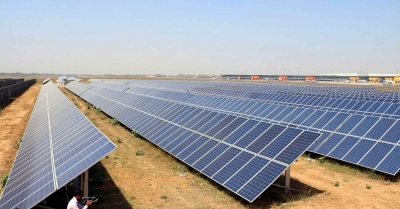
India achieved a milestone by adding a record 15.3 GW of new solar capacity in the first quarter of 2026, the highest quarterly increase in the country to date. This significant growth, as reported by Mercom India Research, represents a 143% surge compared to the same period last year when 6.3 GW was added. Large-scale solar projects dominated the installations, constituting 82% of the total capacity added during the quarter.
The overall power generation capacity in India saw an addition of 19.9 GW in the same quarter, with solar installations contributing 77% to this increase. As of March 2026, the cumulative installed solar capacity in India reached 152 GW, with large-scale projects holding an 85% share and rooftop solar contributing 15%. Solar energy now accounts for 28% of India’s total installed power capacity and 55% of its renewable energy capacity.
Rajasthan emerged as the leading large-scale solar market in India, with 32% of the cumulative installed capacity, followed by Gujarat at 21% and Karnataka at 11%. Gujarat and Rajasthan together represented a significant portion of the new large-scale installations during the quarter. The report highlighted a slight decline in the average cost of large-scale solar projects, although costs remained higher compared to the previous year.
The surge in commissioning activity was attributed to impending policy deadlines and enhanced transmission readiness in key solar markets. Noteworthy drivers included the forthcoming implementation of the Approved List of Models and Manufacturers (ALMM) List-II from June 2026, prompting developers to expedite project commissioning. Additionally, the Pradhan Mantri Kisan Urja Suraksha evam Utthaan Mahabhiyan (PM-KUSUM) scheme and accelerated commissioning of open access projects further fueled installation activity.
Despite the robust project execution and commissioning, challenges persist in transmission readiness and evacuation infrastructure to match the rapid growth in renewable capacity. As renewable energy penetration rises, issues such as curtailment, grid flexibility, and storage integration become crucial for sustaining future growth, noted Mercom Capital Group CEO Raj Prabhu.
