


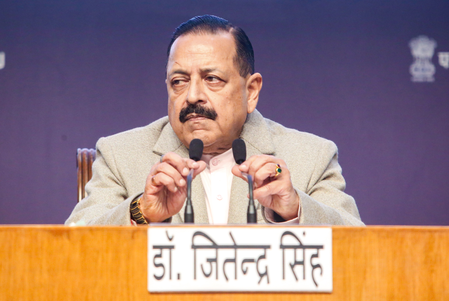
India’s highways are undergoing a transformation from fossil fuels to bio-driven solutions, leading to more budget-friendly, sustainable roads that are eco-friendly, as stated by Union Minister of State for Science and Technology, Dr. Jitendra Singh. Speaking at the CSIR’s ‘Technology Transfer’ ceremony, he emphasized the significance of this shift towards a circular economy approach. This initiative is aligned with Prime Minister Narendra Modi’s vision of a ‘Viksit Bharat,’ emphasizing a holistic national development strategy.
Dr. Singh highlighted the role of technologies like bio-bitumen in supporting national objectives such as cleanliness, self-reliance, and economic growth. He stressed the need for effective communication to ensure broader stakeholder engagement and adoption of innovative solutions. The minister commended CSIR’s efforts in making scientific advancements accessible to citizens, industries, and states over the past decade.
The utilization of bio-bitumen offers a waste-to-wealth solution by addressing various challenges simultaneously, including stubble management, environmental conservation, and reducing imports. With India currently importing around half of its bitumen requirements, innovations like bio-bitumen can significantly reduce foreign dependency while enhancing domestic capabilities. The recent technology transfer event showcased the production of Bio-Bitumen through the pyrolysis of farm residue on an industrial scale.
The successful validation of bio-bitumen technology, which allows for the safe replacement of 20–30% of conventional bitumen without compromising performance, was acknowledged during the event. Dr. Singh praised this innovation as a significant global breakthrough with immense economic potential, estimating the annual replacement of imported bitumen worth Rs 25,000–Rs 30,000 crore. He emphasized the need for region-specific research based on available resources.
N Kalaiselvi, Director General of CSIR and Secretary of DSIR, highlighted India’s pioneering achievement in scaling up bio-bitumen technology for industrial and commercial use within a single year. She explained the multiple value streams derived from biomass pyrolysis, including bio-binder for roads, gaseous fuel, bio-pesticide fractions, and high-grade carbon for various applications, making the process environmentally friendly, cost-effective, and future-oriented. Kalaiselvi proposed policy-level blending of bio-bitumen to facilitate nationwide deployment.
