


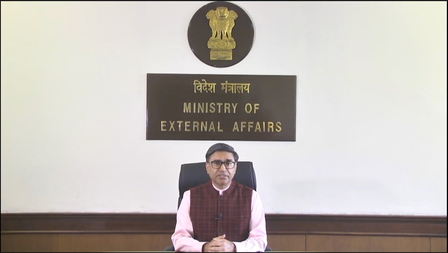
India’s Foreign Secretary, Vikram Misri, highlighted the crucial importance of safeguarding strategic stability and preventing a new global arms race. Speaking at the 2026 High-Level Segment of the Conference on Disarmament in Geneva, Misri expressed concerns over the expiration of the New Strategic Arms Reduction Treaty (New START), emphasizing the significance of maintaining global arms control efforts.
Misri pointed out that the current geopolitical landscape is marked by uncertainties, escalating military expenditures, and challenges to established arms control agreements, alongside rapid technological advancements with military implications. As a responsible nuclear-weapon state, India reiterated its commitment to a credible minimum deterrent and a policy of ‘no-first use’ against non-nuclear-weapon states.
India advocates for universal, non-discriminatory, and verifiable nuclear disarmament through a phased, multilateral approach. Additionally, India supports negotiations on a Fissile Material Cut-off Treaty within the Conference on Disarmament. The country also calls for a comprehensive evaluation of security implications arising from emerging technologies across the UN system.
Regarding artificial intelligence (AI) in the military domain, India stresses the importance of responsible AI deployment with human oversight to ensure compliance with international humanitarian law. The country has established a framework to evaluate trustworthy AI in defense, focusing on principles like reliability, safety, and transparency.
India recently hosted the AI Impact Summit 2026, where the New Delhi Declaration on AI Impact was adopted, emphasizing the need to democratize AI access for inclusive development, especially in the Global South. Foreign Secretary Misri reiterated India’s commitment to peaceful cooperation in outer space and supported negotiations for a binding instrument to prevent an arms race in space.
India reaffirmed its support for the Conference on Disarmament as the primary multilateral disarmament negotiation platform, urging member states to prioritize collective security over individual interests. The country emphasized the importance of constructive dialogue and engagement to address global security challenges.
