


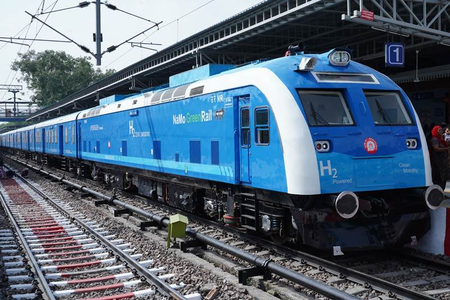
India has reached a significant milestone in sustainable transportation by introducing its first indigenous Hydrogen Fuel Cell Train. This development signifies a crucial step towards establishing a domestic hydrogen-powered rail system and promoting the nation’s clean mobility goals. The train will operate on the Jind-Sonipat section of Northern Railway and has been entirely designed, engineered, and integrated in India using local technology.
With a capacity to accommodate 2,600 passengers, the hydrogen-powered train aims to demonstrate the potential of hydrogen as a clean substitute for traditional diesel-powered rail travel. It operates on a Proton Exchange Membrane Fuel Cell (PEMFC) that generates electricity by combining hydrogen and oxygen through a proton-conducting Perfluorosulfonic Acid (PFSA) polymer membrane. This process results in only water vapor and heat as by-products, making the train an eco-friendly and zero-emission mode of transport.
The train boasts an operational speed of 75 kmph, with a design speed of 110 kmph, enabling efficient service on regional passenger routes while reducing carbon emissions. To support its operation, a dedicated hydrogen refueling ecosystem has been established in Jind, Haryana, encompassing hydrogen production, storage, compression, and dispensing infrastructure. This comprehensive setup facilitates hydrogen-based railway operations.
Safety measures have been a paramount consideration in the project’s development. Equipped with hydrogen leak detectors capable of promptly identifying even the smallest leaks, the train ensures safe operations and mitigates potential hazards. Beyond being a technological breakthrough for Indian Railways, the indigenous hydrogen fuel cell train sets the groundwork for a domestic hydrogen rail ecosystem, underscoring India’s dedication to sustainable, zero-emission transportation solutions.
