


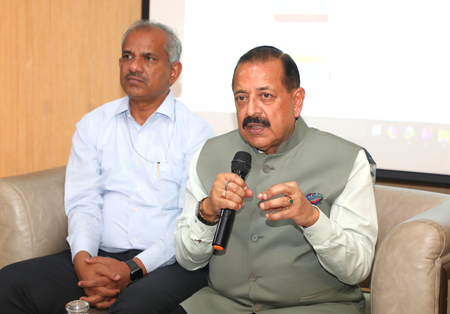
Union MoS Dr. Jitendra Singh inaugurated India’s first SkyCast System at the Indira Gandhi International Airport in New Delhi. This system aims to enhance aviation weather monitoring and reduce disruptions caused by fog. Dr. Jitendra Singh mentioned that only 18 such advanced systems exist globally, with India now hosting the 19th one.
A second SkyCast facility is planned for deployment at Jewar Airport, with future installations scheduled for other airports. The Ministry of Earth Sciences highlighted that the initiative is part of “Mission Mausam,” driven by Prime Minister Shri Narendra Modi’s vision.
Dr. Jitendra Singh emphasized that SkyCast will significantly improve aviation safety by offering real-time weather information to pilots and operators during critical conditions. The system aims to minimize flight disruptions due to fog and turbulence by providing advance alerts to aircrew within short timeframes of around three hours.
SkyCast integrates various atmospheric observation technologies for fog monitoring, turbulence detection, and high-impact weather forecasting. The system incorporates cutting-edge remote sensing technologies like Radar Wind Profiler, SODAR, Microwave Radiometer, Ground-based Fog Aerosol Spectrometer (GFAS), and CL61 Lidar-based Ceilometer.
The advanced boundary layer Radar Wind Profiler at the core of SkyCast continuously measures crucial parameters for aircraft operations, such as wind speed, direction, turbulence, and vertical dynamics up to nearly 3 kilometers above the airport. This data is vital for enhancing safety during aircraft descent and landing.
The CL61 Lidar-based Ceilometer integrated into the system monitors the vertical structure of fog, providing insights into fog formation, visibility reduction, and atmospheric conditions affecting aviation operations. Beyond aviation, SkyCast observations will support various applications, including advanced forecasting models, urban weather forecasting, pollution management, and disaster preparedness initiatives.
