


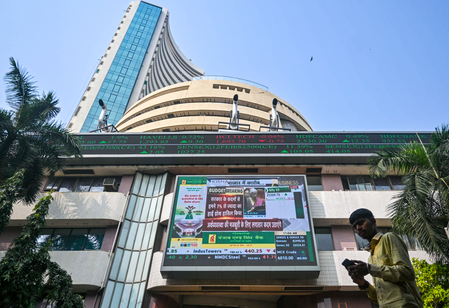
The Indian equity markets experienced moderate losses in early trading on Wednesday due to cautious sentiment surrounding the ongoing conflict between the US, Israel, and Iran, leading to the extended closure of the Strait of Hormuz. The Sensex dropped 109 points, or 0.14%, to 78,096, while the Nifty decreased by 26 points, or 0.11%, to 24,234.
Despite this, the Nifty Midcap 100 saw a gain of 0.72%, and the Nifty Smallcap 100 rose by 0.85%, showing divergence from the benchmark indices. Most sectoral indices were in the green, except for Nifty FMCG, financial services, and private banks, with private banks leading the losses at 0.73%.
Analysts pointed out that the Nifty faces near-term resistance in the 24370-24416 range, with strong support levels between 23700-24080. Derivatives data indicated positive sentiment from foreign investors and proprietary traders, while retail investors took a bearish stance.
Market participants highlighted that Bank Nifty’s resistance is expected around the 57,200–57,300 zone, with support at 56,600–56,700. The previous session saw a recovery led by auto, financials, and consumer-oriented stocks, although some pressure was observed in select IT and oil & gas sectors.
The markets remained uncertain on Wednesday due to diminishing hopes of a swift resolution to the US-Israeli conflict with Iran, compounded by concerns of stagflation following US President Donald Trump’s warnings of retaliation. Oil prices, which had surged to $120 a barrel earlier, fell below $90 amid reports of emergency crude reserves being tapped to alleviate disruptions from the conflict.
International Brent crude stood at $87.39 per barrel, down by 0.44% early Wednesday. In Asian markets, China’s Shanghai and Shenzhen advanced, while Japan’s Nikkei and Hong Kong’s Hang Seng Index also saw gains. South Korea’s Kospi recorded a notable increase as well.
The US markets closed with mixed results, with Nasdaq slightly up by 0.01%, while the S&P 500 and Dow Jones experienced slight declines. On March 10, foreign institutional investors (FIIs) sold equities worth Rs 4,685 crore, while domestic institutional investors (DIIs) bought equities amounting to Rs 6,250 crore.
