


India’s Ayushman Bharat model is being increasingly acknowledged worldwide as a benchmark for countries aiming to establish fair and financially viable healthcare systems. The country’s healthcare reforms in the last decade have positioned India as a standout example in the global drive for Universal Health Coverage (UHC), offering a potentially scalable model for low- and middle-income nations. Ayushman Bharat, an initiative by the Government of India, incorporates financial protection, bolstering primary healthcare, digital advancements, and pharmaceutical self-sufficiency, as highlighted in a report by The Times Kuwait.
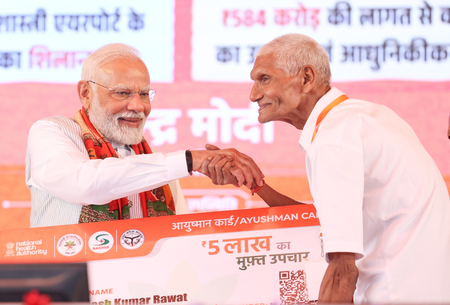
The flagship insurance scheme, Pradhan Mantri Jan Arogya Yojana (PMJAY), part of Ayushman Bharat, stands as the world’s largest publicly funded health assurance program. It grants health insurance coverage of up to Rs 5 lakh annually per family for secondary and tertiary care, facilitating over 7.8 crore hospital admissions since its inception in 2018. Recently, coverage has been extended to all citizens aged 70 and above, irrespective of income levels.
Under Ayushman Bharat, the healthcare infrastructure has significantly expanded through Ayushman Arogya Mandirs (AAMs), offering a wide array of services encompassing preventive, promotive, curative, rehabilitative, and palliative care, thereby enhancing primary care delivery and accessibility to healthcare services within communities. Digital integration has played a pivotal role in enhancing healthcare accessibility, with over 426 million teleconsultations conducted through AAMs in 2025, and the establishment of more than 863 million digital health accounts under the Ayushman Bharat Digital Mission, ensuring secure and interoperable health records.
India has introduced the Tele Mental Health Assistance and Networking Across States (Tele MANAS) initiative, providing round-the-clock tele-mental health services for equitable, accessible, affordable, and quality mental healthcare. Initiatives like the Pradhan Mantri Bhartiya Janaushadhi Pariyojana (PMBJP) and AMRIT pharmacies have contributed to reducing medicine prices, enhancing affordability for millions of people. Experts view Ayushman Bharat as a transformative step in healthcare governance, integrating decentralized primary care, extensive insurance coverage, and digital health infrastructure under a unified rights-based framework, serving as a benchmark for nations striving to establish fair and financially sustainable healthcare systems.
By embedding healthcare in a rights-based and technology-driven framework, India’s approach demonstrates the attainability of UHC even in resource-limited settings, contingent upon robust political commitment and comprehensive reform across systems. The model’s focus on prevention, affordability, and inclusivity positions it as a potential blueprint for the Global South, where governments grapple with balancing limited resources against escalating healthcare needs, as highlighted in The Times Kuwait report.
