


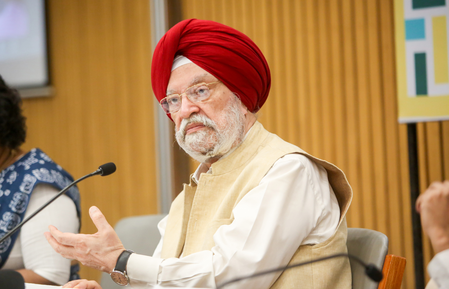
Union Minister for Petroleum and Natural Gas, Hardeep Singh Puri, highlighted the progress of India’s compressed bio-gas and household energy infrastructure, which now boasts 132 compressed biogas plants producing 920 tonnes per day. This initiative, under the Sustainable Alternative Towards Affordable Transportation (SATAT), aims to convert farm and organic waste into clean fuel, boosting rural income and reducing emissions.
The expansion of India’s energy network includes 33 crore Liquefied Petroleum Gas (LPG) households, with 10.35 crore Ujjwala connections and plans for an additional 25 lakh connections. Additionally, there are 1.58 crore piped natural gas (PNG) homes, 8,428 compressed natural gas (CNG) stations, and a growing LNG capacity, reflecting a significant growth in the sector.
Minister Puri emphasized the importance of trust in systems that deliver consistently, attributing the rapid infrastructure expansion to sustained efforts. The energy infrastructure in India, focusing on reliability, efficiency, and future readiness, is evolving under the leadership of Prime Minister Narendra Modi, as stated in a social media post.
The government’s initiatives to enhance natural gas availability for power generation include expanding the National Gas Grid to connect domestic sources and LNG terminals to power plants. Measures such as unified tariffs, setting up LNG Terminals, and granting pricing and marketing freedom to domestic gas producers aim to facilitate the sale of domestic gas through authorized gas exchanges.
