


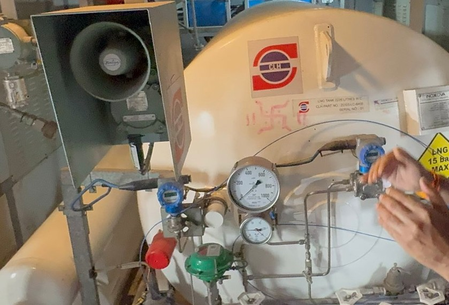
Indian Railways has introduced the country’s inaugural passenger train fueled by liquefied natural gas (LNG) in Ahmedabad, marking a significant move towards cleaner rail transport. This train, now in regular operation following successful trials, can travel up to 2,200 kilometers on a single LNG tank. The shift to LNG technology from conventional diesel operations is seen as a more cost-effective and environmentally friendly approach, as stated by Ahmedabad Divisional Railway Manager Ved Prakash during a media briefing.
The newly launched dual fuel train, which combines diesel and LNG, has undergone modifications to enhance efficiency and reduce environmental impact. This initiative, a first for Indian Railways in passenger service, offers nearly three times the benefits of diesel in terms of efficiency, cost savings, and environmental sustainability. The conversion of Diesel Electric Multiple Unit (DEMU) trains and their Driving Power Cars (DPC) to operate on a diesel-LNG blend has already shown promising results, with two power cars successfully completing field trials exceeding 2,000 kilometers.
The utilization of LNG in these trains has led to a significant decrease in exhaust emissions, resulting in improved air quality along railway routes. Notably, carbon dioxide, nitrogen oxides, and particulate matter emissions are substantially lower compared to traditional diesel operations. The dual fuel system maintains engine output and operational reliability while enabling seamless fuel switching based on availability, ensuring uninterrupted passenger service.
Financially, the conversion to LNG is expected to yield substantial savings for Indian Railways. Estimates suggest annual savings of approximately Rs 11.9 lakh per DPC, with potential savings of up to Rs 23.9 lakh per year for an eight-coach DEMU train equipped with two power cars. Each modified power car is equipped with an LNG tank designed for long-distance travel, further enhancing operational efficiency and cost-effectiveness.
The ongoing trials on the Mahesana–Sabarmati section are progressing well, with plans to extend the LNG technology to additional trains pending mandatory tests and approvals by the Research Designs and Standards Organisation. This initiative underscores Indian Railways’ commitment to reducing emissions, cutting operating costs, and embracing cleaner energy solutions to modernize its services and enhance sustainability efforts.
