


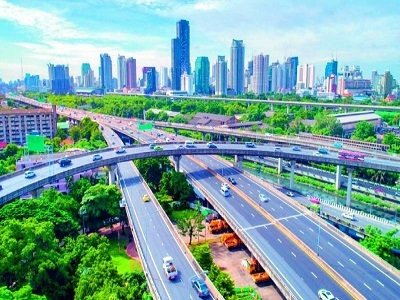
India has significantly ramped up infrastructure development in the last decade, expanding its railway, highway, and airport networks to boost mobility, logistics, and economic activities nationwide. Notably, there has been a shift towards integrated infrastructure planning from the earlier fragmented project execution approach. Public capital expenditure surged from around Rs 2 lakh crore in FY2014–15 to Rs 12.2 lakh crore in FY2026–27, indicating a sustained emphasis on long-term infrastructure growth.
Key initiatives such as Sagarmala, Bharatmala, PM GatiShakti, PMAY, Jal Jeevan Mission, PM Ujjwala Yojana, and UDAN have played pivotal roles in enhancing infrastructure accessibility. These programs have connected infrastructure development with household welfare, economic opportunities, and regional progress.
Indian Railways has witnessed a substantial transformation since 2014, with improvements in capacity, efficiency, safety, and service delivery. Budgetary support for the railways surged from about Rs 32,000 crore in 2014–15 to Rs 2.78 lakh crore in FY2026–27, marking a nearly nine-fold increase. Electrification of the railway network has also made significant strides, reaching 99.6% by March 2026, with 69,873 route kilometers electrified, leading to enhanced energy efficiency and reduced reliance on fossil fuels.
The introduction of indigenous Vande Bharat trains has revolutionized rail travel by offering enhanced speed, comfort, and onboard technology. Currently, 162 Vande Bharat train services are operational across India as of April 2026, with higher-capacity 16-coach and 20-coach configurations improving passenger capacity and accessibility.
India’s road network has expanded substantially since 2014, enhancing connectivity within regions and economic corridors. With a total length of 63.73 lakh km, India boasts the world’s second-largest road network. The length of National highways has increased by 61%, from 91,287 km in FY14 to 1,46,566 km in March 2026, with a notable increase in four-lane and above national highways. Additionally, 3,644 km of access-controlled high-speed corridors/expressways are now operational across the country, focusing on high-speed corridor development, economic node connectivity, and urban decongestion.
