


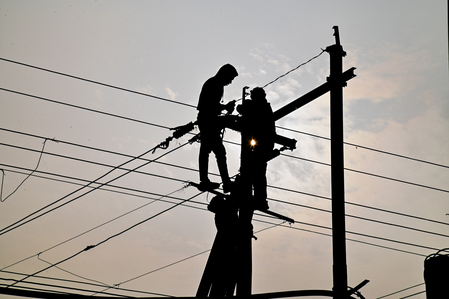
India’s national power transmission network has achieved a significant milestone by surpassing over 5 lakh circuit kilometers (ckm) of transmission lines and 1,407 GVA of transformation capacity. This achievement was announced by the Ministry of Power on Thursday. The world’s largest synchronous national grid reached this milestone on January 14, 2026, with the commissioning of a 628 ckm transmission line of 765 kV from Bhadla II to Sikar II substation for the evacuation of solar power from the Rajasthan renewable energy zone.
With the commissioning of this transmission line, an additional 1,100 MW of power can now be evacuated from the renewable energy zone of Bhadla, Ramgarh, and Fatehgarh Solar Power Complex. Since April 2014, India’s transmission network has expanded by 71.6%, adding 2.09 lakh ckm of transmission lines (220 kV and above) and increasing transformation capacity (220 kV and above) by 876 GVA. The inter-regional power transfer capacity, currently at 1,20,340 MW, facilitates seamless electricity transfer across regions, realizing the vision of “One Nation–One Grid–One Frequency.”
The ongoing inter-state transmission projects will contribute around 40,000 ckm of transmission lines and 399 GVA of transformation capacity. Additionally, intra-state transmission projects in progress are expected to add another 27,500 ckm of transmission lines and 134 GVA of transformation capacity, enhancing grid reliability and power evacuation capability. This increase in transmission capacity will aid in evacuating the growing non-fossil power generation targeted at 500 GW by 2030.
The milestone of 5,00,000 ckm of transmission lines highlights the government’s continuous efforts to ensure reliable, affordable, and secure electricity supply nationwide while supporting the rapid integration of renewable energy.
