


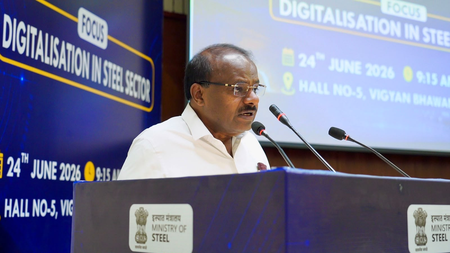
Digitalization has become essential for India’s steel industry to ensure its long-term survival and global competitiveness, according to Union Minister for Steel and Heavy Industries H.D. Kumaraswamy. Speaking at the ‘Chintan Shivir 2026 on Digitalisation in the Steel Sector,’ the minister emphasized that the industry’s future success will depend on its ability to create intelligent, connected, and data-driven manufacturing ecosystems. Prime Minister Narendra Modi’s Viksit Bharat 2047 vision sees the steel sector as a crucial element in India’s economic progress, supporting various sectors like infrastructure, manufacturing, renewable energy, urbanization, transportation, and defense production.
Highlighting the significance of steel in nation-building, Kumaraswamy mentioned that India has maintained its position as the world’s second-largest steel producer since 2018, despite lower demand in some advanced economies. He also pointed out that crude steel production has been growing at an average annual rate of almost 8% since FY22, while finished steel consumption has seen an annual increase of about 13%. The government aims to boost India’s steelmaking capacity to 300 million tonnes by 2030 and 400 million tonnes by 2035, as part of its vision for the sector.
The minister also highlighted the transformative potential of technologies like Artificial Intelligence (AI), Machine Learning (ML), Industrial Internet of Things (IIoT), Digital Twins, Robotics, and Advanced Data Analytics in reshaping the global steel manufacturing landscape. Kumaraswamy emphasized that these technologies can play a crucial role in minimizing unplanned downtime, reducing errors, and enhancing workplace safety. The ‘Chintan Shivir 2026 on Digitalisation in the Steel Sector,’ organized by the Ministry of Steel, brought together government officials, industry leaders, technology experts, startups, and heads of major public sector steel companies such as SAIL, NMDC, and MOIL.
