


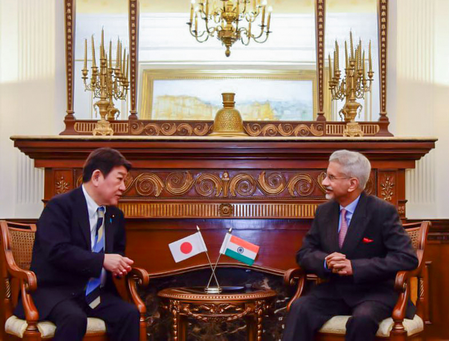
The recent visit of Japanese Foreign Minister Toshimitsu Motegi to India signifies a crucial phase in the relationship between the two countries, transitioning from mere agreements to concrete outcomes. This visit, characterized by strategic dialogues and symbolic gestures, highlights India’s strategic autonomy through diversified partnerships, aiming to uphold free and open Indo-Pacific principles and counter coercion. The engagement between the two nations emphasizes the importance of fortifying alliances in the face of regional assertiveness, particularly from China.
Foreign Minister Motegi’s visit, spanning from January 15 to 17, 2026, showcased a deepening strategic partnership between Japan and India amidst evolving Indo-Pacific dynamics. The high-level dialogues and interactions during this three-day visit underscored India’s commitment to bolstering its economic and security frameworks, aligning with the ‘Japan-India Joint Vision for the Next Decade’ established during Prime Minister Narendra Modi’s visit to Japan in August 2025. The discussions encompassed various aspects including security, economic resilience, innovation, and cultural ties, reflecting a pragmatic shift towards stronger bilateral relations.
During the 18th India-Japan Foreign Ministerial Strategic Dialogue, significant outcomes were achieved, including the initiation of an AI dialogue mechanism and the establishment of a Joint Working Group focusing on critical minerals, particularly rare earth elements and supply chain security. The visit also included a courtesy meeting between Foreign Minister Motegi and Prime Minister Narendra Modi, where discussions revolved around economic security, artificial intelligence, investments, and enhancing people-to-people connectivity. Motegi’s visit further solidified efforts to address China’s maritime assertiveness in the Indian Ocean and its dominance in supply chains, emphasizing the importance of collaborative countermeasures.
In the broader geopolitical landscape, Motegi’s visit to India, part of his 2026 overseas tour following visits to Israel, Qatar, and the Philippines, underscores Japan’s proactive diplomatic stance under Prime Minister Sanae Takaichi. This visit not only highlights Tokyo’s role as a reliable counterbalance to Beijing’s assertiveness but also emphasizes the partnership’s engagement in global platforms such as G20, G4, and the UN to advocate for reformed global governance.
