


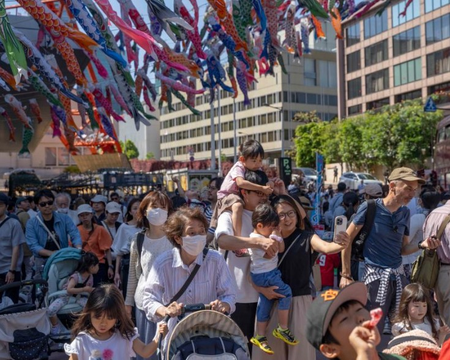
The population of children under 15 in Japan has decreased to around 13.29 million as of April 1, a drop of 350,000 from the previous year, marking a record low. This decline, observed for the 45th consecutive year, comes despite the government’s efforts to address the declining birthrate by providing increased financial support to families with children. The ratio of children under 15 in the total population has fallen by 0.3 percentage points to 10.8 percent, the lowest since 1950, according to the Ministry of Internal Affairs and Communications.
The figures, which include foreign residents, are based on population estimates from a national census conducted every five years. The data shows that there were 6.81 million boys and 6.48 million girls in this age group. The number of children aged 12 to 14 was 3.09 million, while those aged 0 to 2 numbered 2.13 million, indicating a continued decline in births. The total number of children born in Japan in 2025, including foreign nationals, hit a record low of 705,809, marking the 10th consecutive year of decline, as per preliminary data from the Ministry of Health, Labor and Welfare.
Japan has seen a downward trend in its child population since 1982, following a peak of 29.89 million in 1954, with a second baby boom occurring between 1971 and 1974. In a United Nations survey comparing 38 countries with populations of 40 million or more, Japan ranks as the second lowest in terms of the proportion of children, with South Korea having the lowest figure at 10.2 percent.
