


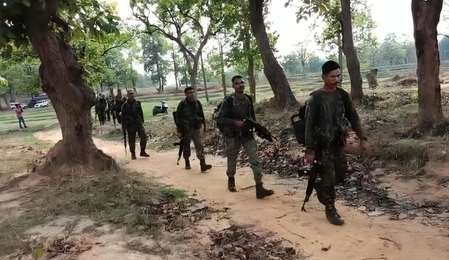
In a successful anti-Maoist operation, a joint team of Narayanpur Police and the Indo-Tibetan Border Police (ITBP) discovered a stash of materials used by Naxalites for creating improvised explosive devices (IEDs) in the dense forests of Narayanpur district, Chhattisgarh. The recovered items were seized, documented, and transferred to Orchha police station for further investigation. Legal action has been initiated against the Naxal elements involved in this incident.
The recovery operation, based on reliable intelligence, focused on hidden deposits in the Kangali-Mandoli-Asnar-Orchha forest area within Orchha police station limits, a part of the infamous Abujhmad region known as a Maoist stronghold. Acting promptly on intelligence received on February 2, the joint force launched a thorough search in the forested area. Security personnel uncovered various items hidden by Maoists, such as pressure cookers, ropes, electrical wires, chargers, batteries, and other everyday materials often repurposed for making IEDs.
These components are commonly used by Maoists to target security forces through explosives triggered by pressure or commands. Recent collaborative efforts in Abujhmad have consistently disrupted Maoist activities, leading to the discovery of explosives, detonators, and pressure cooker-based IEDs in the region, which are frequently neutralized on-site by bomb disposal squads to prevent potential attacks.
Narayanpur, situated in the Bastar division, continues to be a key area for anti-Naxal operations due to its challenging terrain and enduring Maoist presence. In a previous incident in January, a joint security team uncovered and neutralized a significant Maoist explosives cache concealed in the forested hills near Kursingbahar village under Barsur police station in Dantewada district. The seized items included a barrel-type Improvised Explosive Device weighing 174 kilograms, a Barrel Grenade Launcher, cordex wire bundles, electric detonators, gelatin sticks, electric wires, safety fuse bundles, medicines, daily necessities, and Maoist literature. The explosives, valued at around 11 lakh rupees, were strategically hidden to support potential ambushes or acts of sabotage.
