


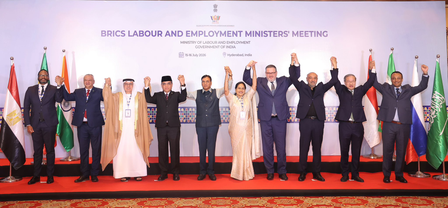
Labour Minister Dr. Mansukh Mandaviya expressed confidence in creating resilient labour markets that are formal, inclusive, and future-ready at the ‘BRICS Labour and Employment Ministers’ Meeting’ in Hyderabad. Under India’s BRICS Chairship 2026, Dr. Mandaviya highlighted India’s consolidation of 29 outdated labour laws into four modern Labour Codes in November 2025, aiming to establish a worker-centric ecosystem for the country’s 1.4 billion citizens.
Dr. Mandaviya mentioned the successful implementation of the e-Shram portal, which has facilitated over 317 million registered unorganised workers in accessing welfare benefits seamlessly. Additionally, the National Career Service portal, integrating job-matching, skills mapping, and counseling services, has been pivotal in extending support to various worker categories, including platform workers, through India’s digital platforms.
India’s efforts in enhancing international labour mobility were underscored by Dr. Mandaviya, who highlighted the country’s role in connecting its skilled workforce with global opportunities. With over 2,100 Global Capability Centres employing 2.35 million professionals and generating significant annual revenue, India stands as a key player in the global workforce landscape.
Gilbert F. Houngbo, Director General of the International Labour Organization (ILO), lauded India’s leadership in prioritizing labour and employment within the BRICS agenda. He commended India’s robust social security ecosystem, which has witnessed substantial growth, now benefiting approximately 1 billion people. Houngbo emphasized the potential for South-South cooperation in sharing India’s social protection system’s success as a valuable lesson for other nations.
The BRICS Labour and Employment Ministers’ Meeting concluded with the adoption of the BRICS Labour and Employment Ministers’ Declaration, signifying the collective commitment of BRICS nations to promote decent work, strengthen social protection systems, enhance employability, support inclusive growth, and foster cooperation in the labour and employment sector.
