


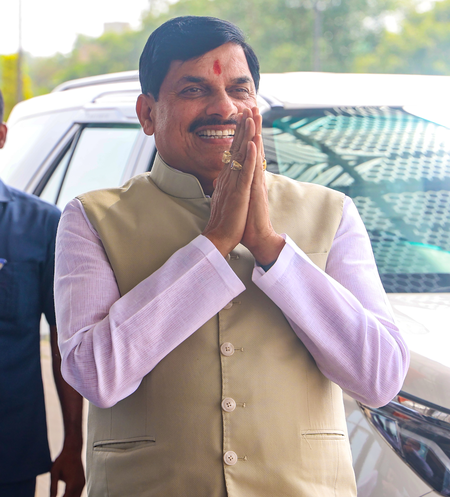
Madhya Pradesh Chief Minister Mohan Yadav criticized the Congress for its stance on the proposed Uniform Civil Code (UCC). He urged the opposition party to clarify its position following the submission of the state government’s high-level committee report. Yadav accused the Congress of approaching issues like the UCC and the Bhojshala dispute from a perspective of “Hindu-Muslim politics” and vote-bank considerations.
The Chief Minister highlighted the broad public participation in the consultation process conducted by the committee. He emphasized that people from various religions expressed their opinions on the Uniform Civil Code. Despite this, Yadav noted that the Congress had not yet disclosed its stance on the matter.
The high-level committee, led by retired Supreme Court judge Justice Ranjana Prakash Desai, submitted its final report to the Chief Minister. The committee was tasked with assessing the feasibility of implementing a Uniform Civil Code in Madhya Pradesh and proposing a legal framework.
The report, compiled in three volumes, includes recommendations, a draft UCC Bill specific to Madhya Pradesh, and details of extensive public consultations. Over 9.58 lakh suggestions were received and analyzed based on questions, gender, and communities. One of the key recommendations is to exclude Scheduled Tribes from the proposed Uniform Civil Code, considering their distinct customary practices and constitutional safeguards.
The submission of the report signifies a significant step in the BJP government’s efforts to introduce a Uniform Civil Code in Madhya Pradesh. The state government will now review the recommendations and the draft legislation before deciding on the next course of action for introducing the Bill in the Assembly.
The Uniform Civil Code, outlined in Article 44 of the Constitution as a Directive Principle of State Policy, aims to establish a common legal framework for civil matters like marriage, divorce, adoption, inheritance, and succession. It intends to replace religion-based personal laws while safeguarding the constitutional rights of specified communities.
