


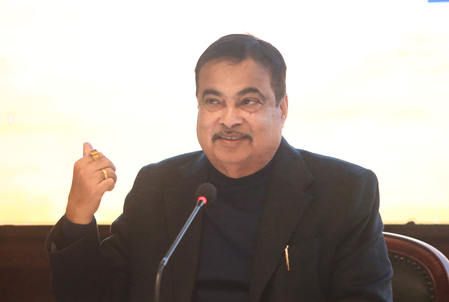
Saturday marks a significant milestone for Madhya Pradesh’s road development as Union Minister for Road Transport and Highways Nitin Gadkari is set to inaugurate completed sections and lay foundation stones for new segments of eight national highway projects valued at over Rs 4,400 crore. The event, scheduled in Vidisha at the old Mandi, will see Chief Minister Dr. Mohan Yadav and Union Minister Shivraj Singh Chouhan in attendance, signifying a new phase of progress for the state, as per a BJP local office-bearer.
These projects cover a combined length of approximately 181 kilometers, enhancing connectivity across Central India with a focus on the Bundelkhand belt. The improvements are expected to facilitate regional economic growth, industrial development, and easier daily commuting. The completion of these national highway projects is anticipated to streamline traffic flow along key industrial, agricultural, and tourism routes, including the crucial Bhopal-Vidisha-Sagar-Rahatgarh-Biaora stretch, as mentioned by a local BJP official.
The four-lane expansion work aims to significantly reduce travel time, leading to fuel savings, lower vehicle emissions, and improved road safety standards. Specific enhancements such as black spot corrections, underpasses, and geometric redesigns have been implemented to decrease the likelihood of accidents. Alongside the highway projects, foundation stones will be laid for three modern driving training centers, focusing on safe driving practices and skill development. These centers, following the Ministry of Road Transport and Highways’ guidelines, aim to reduce road accidents and create job opportunities for young individuals.
A key project includes the four-lane widening of the 12-kilometer Abdullaganj-Itarsi section passing through the Ratapani Wildlife Sanctuary area, costing Rs 418 crore. This stretch is crucial for the Obedullaganj-Itarsi Betul corridor, improving access to Nagpur via Betul. The road widening is expected to ease traffic flow, saving time and reducing fuel consumption and pollution. To protect biodiversity, the design features dedicated animal underpasses and sound-insulated corridors to facilitate safe wildlife crossings and minimize human-wildlife conflicts in the region.
