


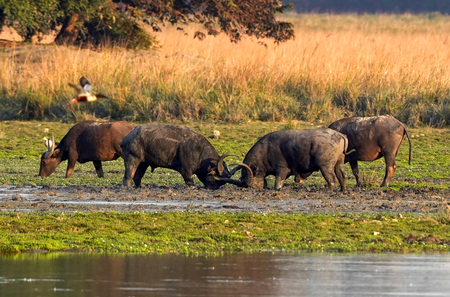
Madhya Pradesh is gearing up for the return of wild buffaloes after more than a hundred years, with Chief Minister Mohan Yadav leading the reintroduction program in Balaghat. The initiative will kick off in the Supkhar and Topla areas of the Kanha Tiger Reserve, where four wild buffaloes – three females and one male – will be released into their natural habitat.
This marks the initial phase of a comprehensive plan to establish a sustainable wild buffalo population in the state. The buffaloes are being relocated from Kaziranga National Park, which currently boasts one of the largest populations of this species. A total of 50 buffaloes will be introduced gradually as part of a carefully planned “founder population,” with eight animals set for relocation in the current season.
The translocation process is under strict supervision by experts and veterinarians from both reserves. Additionally, this program signifies a broader wildlife cooperation agreement between Madhya Pradesh and Assam. As part of this collaboration, two pairs of rhinos will be brought to Van Vihar National Park, while Madhya Pradesh will send three tigers and six crocodiles to Assam.
The agreement was formalized following discussions between Chief Minister Mohan Yadav and Assam Chief Minister Himanta Biswa Sarma. Chief Minister Yadav emphasized the importance of reintroducing wild buffaloes, which, along with the success of Project Cheetah, will enhance the state’s biodiversity and ecological equilibrium. He highlighted Madhya Pradesh’s reputation as the “Tiger State” and “Leopard State,” showcasing its expanding conservation endeavors.
Wild buffaloes had vanished from the region due to extensive hunting, habitat destruction, and human intervention, with the last sighting recorded in Kanha’s Supkhar region dating back to 1979. A study by the Wildlife Institute of India pinpointed Kanha’s grasslands, water availability, and minimal human disruption as ideal for their reintroduction.
